Quick answer: is there a bad Rice Purity score?
No single Rice Purity Test score is automatically bad. People often describe lower scores as "bad" because a low number means you checked more of the 100 prompts. But the test is a private reflection checklist, not a moral rating system.
A low score can be worth thinking about if it points to pressure, unsafe situations, regret, substance-related risk, or experiences you did not want. A high score can also become unhealthy if people use it to feel superior or shame others. The useful question is not "Am I bad?" It is "Does this score make sense for my age, boundaries, and real experiences?"
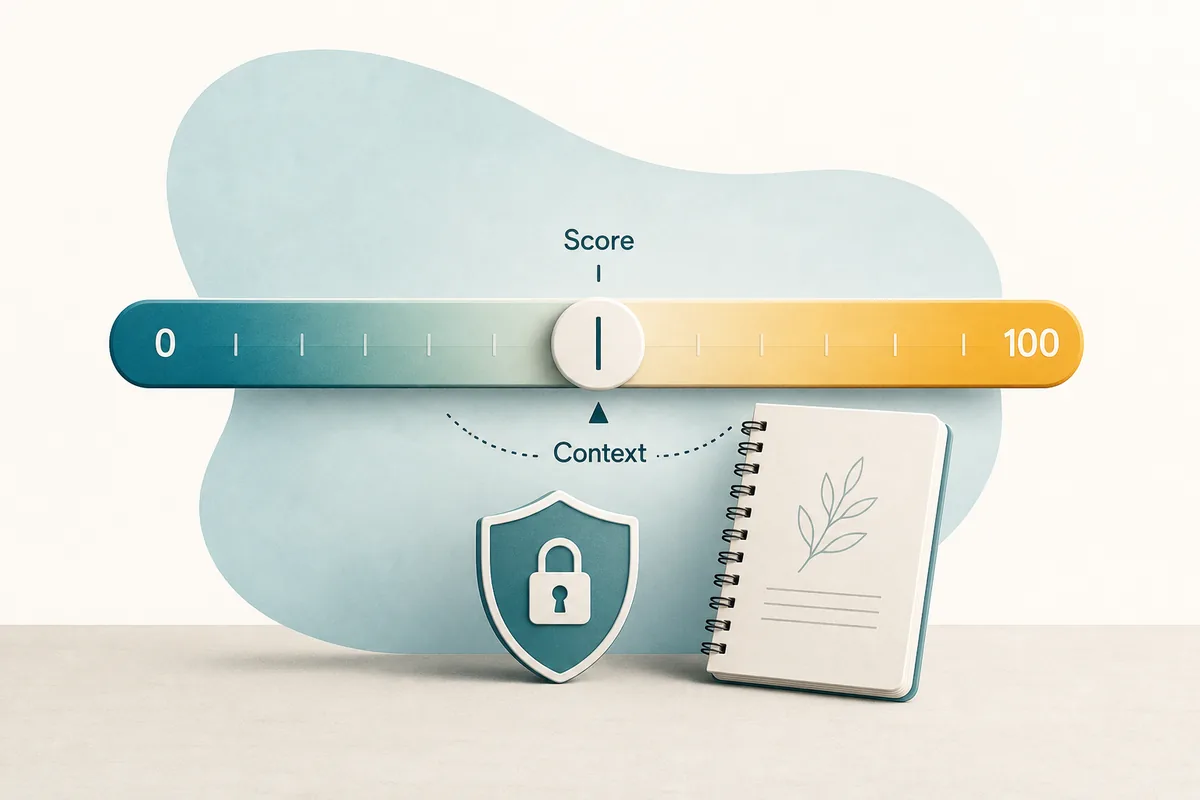
How the score works before you judge it
The standard Rice Purity Test uses 100 prompts. In the common online scoring method, you start with 100 and subtract one point for every item you check. A score of 80 means 20 checked items. A score of 40 means 60 checked items. A score of 0 means all listed items were checked.
The official Rice Purity Test describes the quiz as a voluntary social activity connected with Rice student culture and explicitly frames it as a bonding and reflection exercise rather than a bucket list. Public background sources also describe purity tests as self-graded surveys about supposed innocence, usually scored from 0 to 100.
For source context, see the Rice Purity Test site, Rice University's archive record for Purity Test materials, and the broad purity test overview.
| Score | Checked items | What the number literally says | What it does not prove |
|---|---|---|---|
| 90 | 10 checked | Few listed experiences apply. | It does not prove maturity, kindness, or superiority. |
| 70 | 30 checked | Some experience, with most items still unchecked. | It does not prove someone is sheltered or experienced enough. |
| 50 | 50 checked | Half the list applies. | It does not explain whether the experiences were healthy. |
| 30 | 70 checked | Many listed experiences apply. | It does not make the person bad. |
So why do people call some scores bad?
Most "bad score" talk comes from social comparison. Someone sees a lower number than expected, hears friends react, and starts treating the score like a public label. That is not a helpful way to use the test.
Search results and forum discussions often frame the scale in a simple way: higher means more "pure" and lower means less "pure." That shorthand is easy to understand, but it can also be harsh. It turns a private checklist into a ranking system, especially for teens and college students who may already feel pressure to match a friend group's pace.
A number
The score counts checked boxes. It does not know your age, values, consent, safety, or feelings.
A social reaction
Friends may call a score good, bad, high, or low, but that reaction is shaped by the group.
A real story
The real meaning lives in what happened, whether it was wanted, and how you feel now.
If the concern is simply "my score is lower than my friend's," pause before making it a problem. Different people grow up with different rules, opportunities, relationships, and timelines. A single number cannot compare all of that fairly.
Score ranges: good, bad, or just context?
The table below gives a practical answer to the question without pretending the test is scientific. These ranges are best read as broad context. For a deeper range-by-range view, use the Rice Purity Test score chart or the score ranges guide.
| Score range | Common label | Better interpretation | Best action |
|---|---|---|---|
| 90-100 | Very high | Very few listed experiences. Often common for younger teens or more private people. | Do not treat it as superiority. Keep your own pace. |
| 70-89 | High to moderate | Some listed experiences, many unchecked items. Often a normal high-to-middle band. | Use age context. Compare with the 70 score guide or 76 score guide. |
| 50-69 | Middle | A broad middle range where many users ask whether the score is normal. | Look at age, privacy, and whether checked items were wanted. |
| 30-49 | Low | Many prompts apply. It may reflect age, lifestyle, social environment, or difficult experiences. | Reflect without shame. Do not ignore unsafe or unwanted parts of the story. |
| 0-29 | Very low | Most listed experiences apply. The score may look dramatic, but the number still lacks context. | Focus on health, consent, privacy, and support if any item still bothers you. |
A low score is not automatically bad
A low score only says that many experiences on the checklist apply to you. It does not say whether they were positive, neutral, risky, regretted, private, funny, embarrassing, or meaningful. Two people can have the same score and completely different histories.
For example, one person may score low because they are older and have had a long adult life. Another may score low because they grew up in a party-heavy college environment. Another may score low because some experiences happened under pressure. Those are not the same situation.
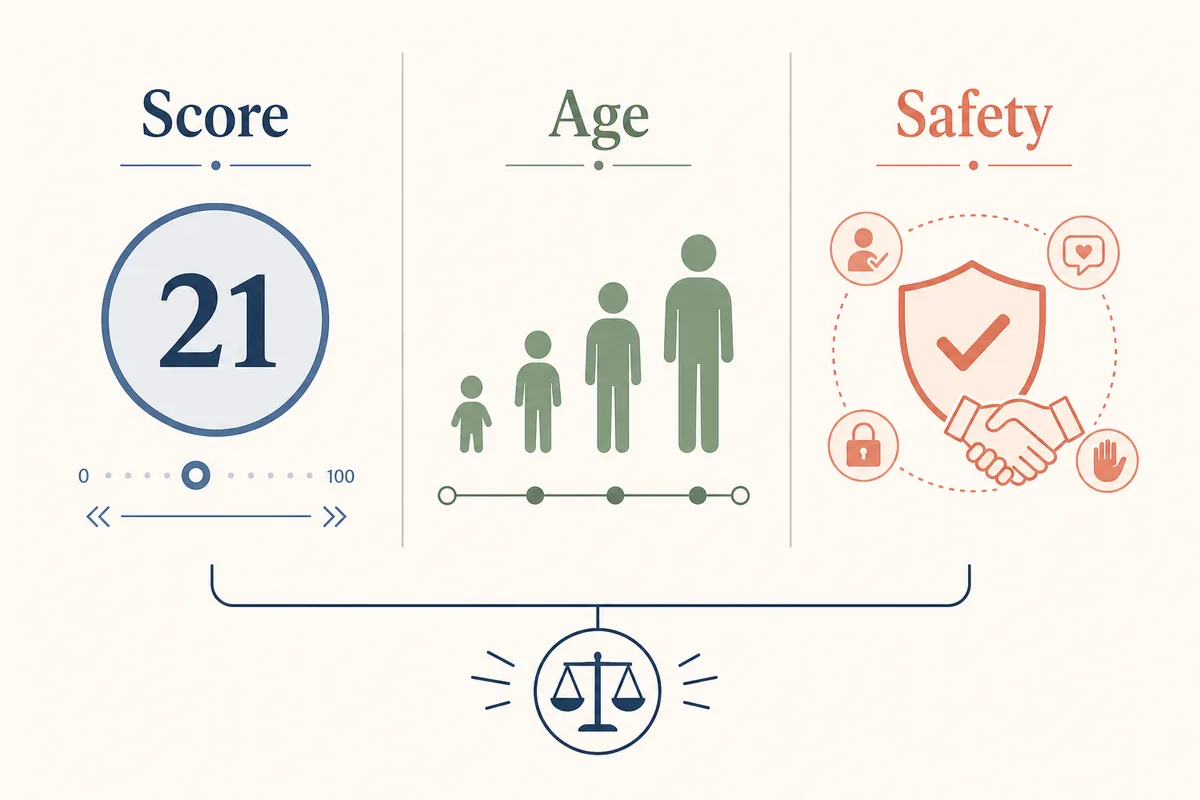
For a plain-language reference on consent, RAINN's guide to what consent means is a useful starting point. If you are a minor or you feel unsafe, talk with a trusted adult, counselor, medical professional, or local support service.
What counts as a good Rice Purity score?
A good score is not a specific number. It is a score you can read honestly without using it to shame yourself or impress someone else. Higher scores usually mean fewer listed experiences, but fewer experiences do not automatically mean someone is better, safer, wiser, or happier.
The healthiest interpretation is values-based rather than rank-based:
- Privacy: you do not owe anyone your exact score or checked items.
- Consent: wanted experiences and unwanted experiences should not be emotionally treated the same.
- Age: the same score reads differently at 14, 18, 25, and 35.
- Pattern: a cluster of risky items may matter more than the final number.
- Feelings now: regret, fear, pressure, or confusion deserves attention beyond the quiz.
How age changes the meaning of a "bad" score
Age is one reason a universal bad cutoff does not work. A score that feels low for a younger teen may be ordinary for a college student. A score that feels high in one friend group may feel average in another. The test measures accumulated experiences, and time naturally changes the odds that more prompts will apply.
| Age or stage | How to read a lower score | Helpful next page |
|---|---|---|
| 13-15 | Read carefully. A lower score may need privacy, safety, and adult support rather than public comparison. | Rice Purity Test for 15 year olds |
| 16-18 | Scores spread out more. Peer pressure can distort what feels normal. | Rice Purity Test for 17 year olds |
| College age | Middle or lower-middle scores may be common depending on social environment and lifestyle. | Average Rice Purity score |
| Adults | A lower score may simply reflect more years of life. It is usually less useful as a comparison game. | Rice Purity score meaning |
When the score should make you pause
The number itself is not the warning sign. The warning signs are the feelings and circumstances around the checked items. A high score can still come with anxiety. A low score can still come with healthy, wanted experiences. The score is only a doorway into a better question.
Pause if the result feels unsafe
- You felt pressured to check or share items.
- A checked item involved coercion or unwanted contact.
- The score makes you want to change your behavior to fit in.
- Friends are using the score to shame or rank people.
Relax if the concern is comparison
- Your score is simply different from a friend's.
- You are older or younger than the people you compare with.
- Your values or boundaries are different.
- You took the quiz for curiosity, not public judgment.
FAQ
What is a bad score on the Rice Purity Test?
There is no universal bad score. Lower scores mean more checked items, but they do not make the person bad. A score becomes concerning only when the experiences behind it involve pressure, danger, regret, or unwanted events.
Is 50 a bad Rice Purity score?
Not automatically. A 50 means 50 checked items and 50 unchecked items. It is a middle-to-lower score, but age and context matter more than the number alone. If you want a nearby breakdown, read our 45-55 score meaning guide.
Is 70 a good Rice Purity score?
Many people treat 70 as a high-to-middle score because it means 30 checked items. It is often normal for older teens, college students, and young adults. The 70 score guide explains that number in more detail.
Is a higher Rice Purity score always better?
No. A higher score means fewer listed experiences, but "better" depends on your own boundaries, age, values, and wellbeing. High scores should not be used to shame people with lower scores.
Should I share my score with friends?
Only if you want to. The test asks personal questions, and you do not owe anyone your score or your checked-item details. If sharing would lead to teasing, pressure, or gossip, keep it private.
Bottom line
A "bad Rice Purity Test score" is usually a social label, not a real category. The score counts experiences from a checklist. It does not measure worth, character, safety, maturity, or whether the experiences were chosen freely.
If your goal is simple interpretation, use the score scale. If your concern is the opposite question, read what counts as a good Rice Purity score. If your goal is to understand your own result, pair the number with age, privacy, consent, and emotional context. That will tell you more than any good-or-bad label.
Next step
If you want to compare your score carefully, start with the broad score scale before looking at exact-score guides.
View Score Scale Take the Test