Rice Purity Test Score Chart: What Your Score Means by Range, Age, and Average
Some articles make Rice Purity scores sound dramatic, mysterious, or oddly scientific. Real life is gentler than that. A score can be useful as a snapshot of experiences, but it only becomes meaningful when you pair the number with context: your age, your stage of life, and the kind of environment you have grown up in.
Quick Answer
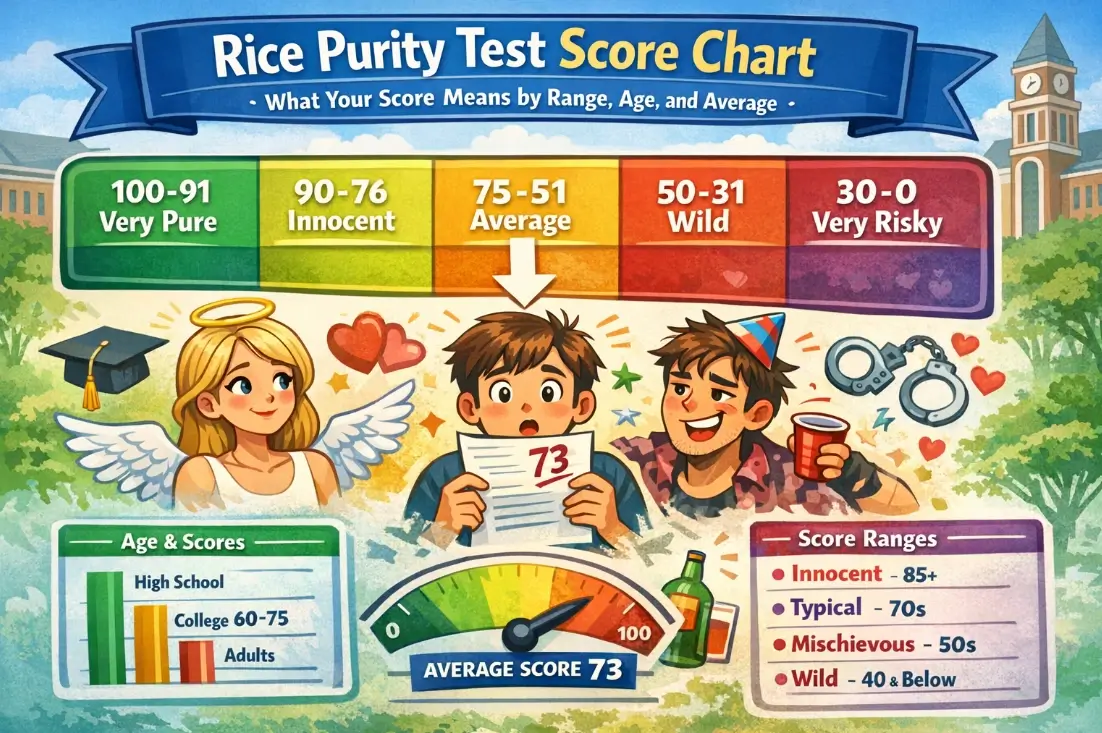
The Rice Purity Test usually gives you a score from 0 to 100. In the standard online format, a higher score means fewer listed experiences, while a lower score means more listed experiences. Most readers are not really asking whether their number is "good." They are asking what it means in plain English, whether it is typical for their age, and how it compares with the broad middle of the pack.
If you only need the fast version, use the score chart below. If you want the richer answer, keep reading for age context, average-score guidance, and the limits of what this test can actually tell you.
| Score | Fast meaning |
|---|---|
| 90-100 | Very few listed experiences |
| 70-89 | Higher-than-average purity |
| 50-69 | Middle range for many users |
| 30-49 | Broad experience range |
| 0-29 | Very extensive listed experiences |
How the Rice Purity Test score is usually calculated
The modern web version of the Rice Purity Test is commonly presented as a list of 100 prompts. The standard scoring logic is simple: you check the experiences that apply to you, then subtract the number of checked items from 100. So if you checked 28 items, your score would typically be 72.
That sounds tidy, but interpretation is where things get slippery. The test does not measure kindness, wisdom, maturity, intelligence, or emotional health. It measures whether a list of specific experiences applies to you. That distinction matters, especially if you are comparing yourself to friends, classmates, or strangers online.
Editorial note
This article follows an E-E-A-T-friendly approach:
- clear sourcing for historical claims
- careful wording around averages
- no moral judgment attached to scores
- plain-language interpretation over hype
Full Rice Purity Test score chart
This table is designed for the search intent behind terms like rice purity test score chart and rice purity test score meaning chart. It gives a quick, readable translation of the score into normal language. The wording is intentionally balanced: a score can suggest a pattern of life experiences, but it should never be treated like a judgment label.
| Score range | Headline interpretation | What it often suggests | Important context |
|---|---|---|---|
| 90-100 | Very high purity | Very few of the listed experiences apply so far. | Common among younger teens, cautious personalities, or people from stricter family or cultural settings. |
| 80-89 | High purity | You have some experience, but most items still do not apply. | Often typical for teenagers and younger users who are still early in the usual social timeline. |
| 70-79 | Above-average purity | You likely have had a modest range of experiences but still remain on the less-experienced side of the scale. | Could feel very average in one friend group and very high in another. |
| 60-69 | Middle range | A balanced or broadly typical range for many college-age and young adult users. | This is the zone many people mean when they ask if their score is "normal." |
| 50-59 | Moderately experienced | You have checked off a substantial part of the list. | Still very common, especially in college and post-college social circles. |
| 40-49 | Lower purity | Your score suggests broad experience across multiple categories on the test. | This is not automatically risky or unhealthy. It is simply more experience on this particular checklist. |
| 30-39 | Broad experience range | Many items on the test now apply to your life. | Interpret with care. Age, environment, and personal history matter a great deal here. |
| 0-29 | Very extensive listed experiences | You have checked off most items in the standard list. | The test records scope of experiences, not whether those experiences were positive, neutral, safe, or harmful. |
What your score means by range
90 to 100: This range is often read as "very innocent," but that phrasing can feel simplistic. A high score usually just means your life is still in an early chapter, or that your choices have been more cautious, private, selective, or values-driven. For teenagers, especially, a high score is frequently ordinary rather than exceptional.
70 to 89: This is the range where many readers start wondering whether they are above average. In practical terms, it usually means you have had some experiences but not many of the ones listed on the test. It can also reflect a slower social timeline, which is not a flaw. Plenty of people mature into adulthood with this kind of score and feel perfectly comfortable there.
50 to 69: This is the most useful range to explain carefully, because it often includes readers who feel "average but unsure." A middle score generally means you have had a moderate spread of experiences, neither close to the maximum nor close to the minimum. For many college-age and young adult users, this range feels familiar. If you want a deeper interpretation, our full guide to score ranges breaks the middle bands down in more detail.
30 to 49: Here the number starts to look low enough that some people feel judged by it. That reaction is understandable, but the score itself is not a verdict. It simply means a wider share of the list applies to you. Whether that reflects curiosity, social openness, independence, college life, or other factors depends on your story, not on the number alone.
0 to 29: This range signals that many items on the standard list apply. It can look dramatic on a chart, but even here the best interpretation is still context-rich. A low score does not say whether those experiences were wanted, safe, joyful, regretted, or meaningful. It only says they are on your personal checklist.
What is the average Rice Purity score?
This is one of the places where many articles overreach. They publish one neat number and present it as settled truth. In reality, reported averages vary by dataset, age group, country, friend group, and platform. A college-heavy sample tends to look different from a teen-heavy sample. A sample built from one site audience can differ from another site audience by quite a lot.
So how should readers use the idea of an average? As a soft benchmark, not a hard rule. If your score sits in the low 60s or upper 60s, many web guides would describe that as broadly middle-range. But the better question is not "Am I at the exact average?" It is "Does this score make sense for my age and stage of life?"
That is why this page treats average-score language with caution. The most trustworthy guidance is to talk in bands, not pretend that one number explains everyone. If you want a longer discussion of how averages are framed across age groups, visit our average Rice Purity Test score guide.
| Question readers ask | Better answer |
|---|---|
| What is the official average? | There is no single universally accepted official average for all modern web users. |
| Is 68 average? | It is often treated as a rough middle-range benchmark online, but it still depends on sample and age. |
| Is 80 high? | Usually yes, but it can be very normal for younger teens. |
| Is 45 low? | It is on the lower side of the chart, but it is still a common real-world score for many adults and college-age users. |
Rice Purity score by age
Age is the missing ingredient in most score explanations. The same number can look very different depending on whether the person taking the test is 14, 19, 26, or 38. That is not because one age is "better" than another. It is because time naturally changes the odds that more items on the checklist will apply to you.
What follows is not a diagnostic scale. It is a practical interpretation framework built for readers who want to place their score in a more human context.
| Age group | How scores are often interpreted | What to keep in mind |
|---|---|---|
| 13-15 | Higher scores are extremely common and often fully expected. | If a younger teen has a very high score, that is usually ordinary, not unusual. See our 13-year-old guide and 14-year-old guide. |
| 16-18 | Scores may begin to spread out more, but many teens still land in the high ranges. | Peer comparison can distort expectations. One friend group is not a universal standard. |
| 18-22 | This is the age band where many readers see scores move toward the middle. | College, work, independence, and social experimentation often widen the spread here. |
| 23-29 | Middle and lower-middle scores may become more common as experience accumulates. | Personal values and lifestyle choices create big variation in this group. |
| 30+ | The chart becomes less useful as a comparison game and more useful as a reflective snapshot. | A lower score is not surprising with time. It may simply reflect a longer life history. |
If your main question is age-specific, our Rice Purity Test for teens guide goes deeper into how younger readers often interpret the test and why a high score is often healthier and more typical than social media makes it sound.
Why the score chart is useful, and where it stops being useful
What the chart does well
- translates a number into a readable range
- helps users find broad context quickly
- reduces the urge to overreact to one result
- creates a bridge to more detailed interpretation
What the chart cannot do
- measure character, morality, or emotional maturity
- tell whether experiences were healthy or unhealthy
- predict future choices or relationships
- replace personal judgment, boundaries, or values
That limit matters for Google-friendly quality too. Pages that perform well over time usually do not exaggerate certainty. They explain what a tool can do, and they are equally clear about what it cannot do.
A short note on history and sources
The Rice Purity Test did not emerge from nowhere. It has roots in Rice University campus culture, and publicly available Rice archival materials show that purity-test documents circulated in university life in the 1990s. For readers who want a broader overview of the wider purity test genre beyond Rice, Wikipedia's overview of purity tests is a convenient starting point.
These links serve different purposes: the Rice archive supports the campus-history angle, while the nofollow encyclopedia link offers broad background reading. Neither link is here to send you to a competitor; they are here to strengthen context and transparency.
How to read your score without spiraling
As someone who believes internet culture is easier to live with when we bring a little tenderness to it, I think the healthiest way to read this chart is to resist the two common extremes. The first extreme is self-congratulation: treating a high score as proof of superiority. The second is self-criticism: treating a low score as proof that something is wrong with you. Both miss the point.
Your score is just a compressed summary of checked boxes. Life, meanwhile, is complicated and textured and wildly specific. Two people can have the same score for completely different reasons. One may be introverted and careful. Another may come from a strict household. Someone else may simply be younger. On the lower end, one person may be adventurous and socially outgoing, while another may have had a difficult or unstable past. A chart cannot tell the difference. Human judgment can.
That is why the most useful next step after seeing your number is not comparison but reflection. Ask: does this score feel aligned with my values, comfort level, and life stage? If yes, wonderful. If no, that is still useful information, because it tells you where you may want clearer boundaries, wiser choices, or a kinder perspective on yourself.
Frequently asked questions
Final takeaway
The best Rice Purity Test score chart does not merely sort people into neat little boxes. It gives the number shape, then gives the reader perspective. A score in the 80s can be perfectly normal. A score in the 50s can be perfectly normal. A score in the 30s can still tell an ordinary story, depending on the life behind it.
If you remember only one thing, let it be this: the score measures listed experiences, not your worth. Use the chart as a translation tool, not a judgment machine.
Take the Rice Purity Test Read More Guides