Average Rice Purity Score by Age
Use age, life stage, and score range together to interpret an average Rice Purity score. A score near 68 is common overall, but the same number can mean something different for a 15-year-old, a college student, or an older adult.
Understanding the Global Average Rice Purity Test Score
Based on extensive data collected from over 100,000 participants worldwide, the global average Rice Purity Test score is 68, with a standard deviation of approximately 14 points.
The Rice Purity Test, originally created by Rice University students in the 1980s, has become a popular online self-assessment tool. This innocence test consists of 100 questions covering various life experiences across categories such as relationships, substances, and academic integrity. A higher score indicates fewer experiences in these areas, suggesting greater "purity" or innocence.
Average Rice Purity Score by Age: Quick Benchmarks
Most readers use this page to answer one question: is my Rice Purity score average for my age? The table below gives a fast, age-adjusted comparison before the deeper charts and demographic notes.
| Age or life stage | Typical average range | Best interpretation |
|---|---|---|
| 13-15 | 82-90 | High scores are common because many listed experiences are age-inappropriate or have not happened yet. |
| 16-18 | 72-84 | Scores vary widely based on independence, dating, school culture, and family boundaries. |
| 19-22 | 58-70 | This is usually the fastest-changing period because college, work, relationships, and social life shift quickly. |
| 23-29 | 50-64 | Lower averages usually reflect accumulated experience, not a better or worse personal path. |
| 30+ | 45-62 | Adult scores are harder to compare because life circumstances differ more than age alone suggests. |
Use these ranges as broad entertainment benchmarks. They are most useful for self-reflection, not diagnosis, ranking, or moral comparison.
Average Score vs. Score Meaning vs. Score Range
Several Rice Purity searches sound similar, but they need different answers. This page owns the average Rice Purity score intent, especially age-based averages. Use the linked pages when you need an exact-score or 0-100 range explanation.
| User question | Best answer | Recommended page |
|---|---|---|
| Is my score average for my age? | Compare your result with age and life-stage benchmarks. | This average-score guide |
| What does my exact number mean? | Translate the score into checked experiences and context. | Rice Purity Test score meaning |
| Which broad range am I in? | Use the 0-100 range categories and labels. | Score ranges explained |
| How does the scoring scale work? | Review the scoring system and 100-question calculation. | Rice Purity Test score scale |
What Is a Good Rice Purity Score?
The most honest answer is that a good Rice Purity score is a score you can understand without shame, pressure, or competition. Searchers often use "good" to mean one of three things: common for my age, higher than average, or personally comfortable.
| Meaning of "good" | How to interpret it | Best next page |
|---|---|---|
| Common for my age | Compare your result with the age bands on this page. | This average-score guide |
| High or "pure" | Use the range table to see whether the number sits above the broad middle. | Score scale |
| What my exact number means | Translate the number into checked experiences and context. | Score meaning |
A higher number is not automatically "better," and a lower number is not automatically "bad." The useful question is whether the score reflects experiences you understand, consented to, and feel safe about.
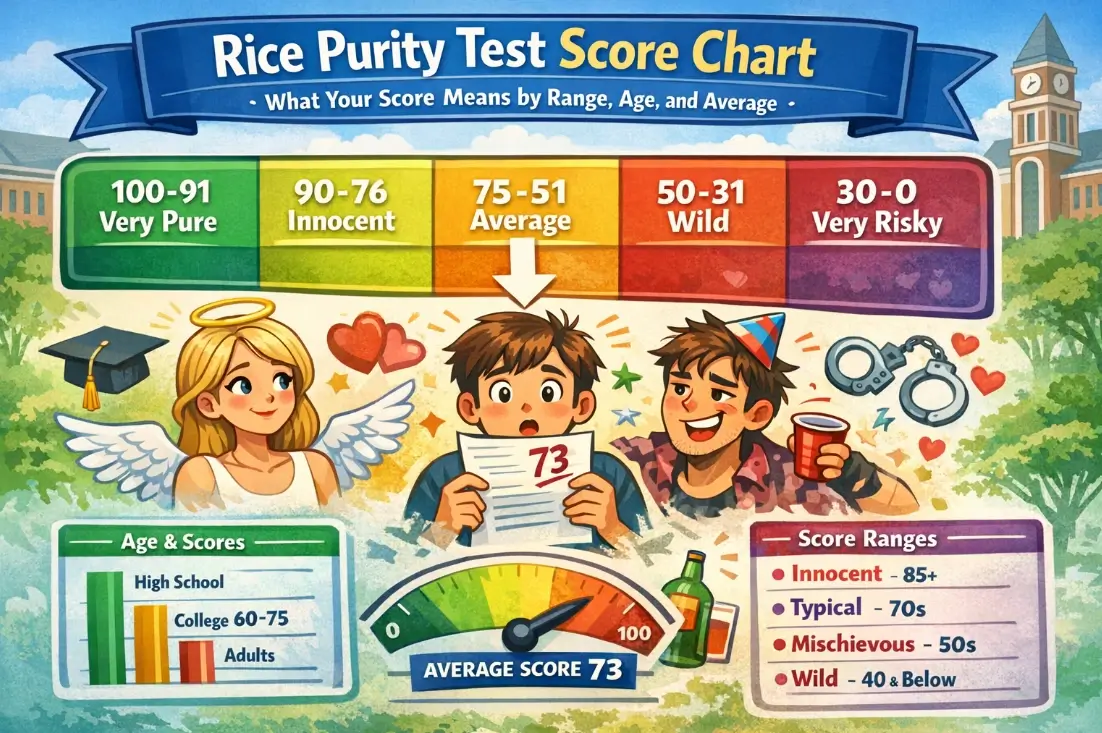
What Does the Average Score Mean?
The average score of 68 represents a moderate level of life experiences. Someone with this score has likely had significant life experiences in certain areas while remaining unexperienced in others. However, individual scores should always be interpreted in context, considering factors like age, cultural background, and personal values.
Rice Purity Test Score Distribution
Average Rice Purity Test Scores by Demographics
Rice Purity Test scores show significant variation across different demographic factors. Our research indicates that age, gender, geographic location, and educational background all influence average scores. Understanding these variations provides valuable context for interpreting your own score.
Average Scores by Age Group
| Age Group | Average Score | Sample Size | Score Range (5th-95th percentile) |
|---|---|---|---|
| 14-17 years | 82 | 15,400 | 69-94 |
| 18-22 years (College age) | 67 | 38,200 | 48-86 |
| 23-29 years | 59 | 27,600 | 42-78 |
| 30-40 years | 54 | 14,300 | 38-72 |
| 41+ years | 61 | 8,500 | 45-79 |
Average Scores by Gender
Interpretation of Gender Differences
Our data shows that female participants tend to have slightly higher average scores (71) compared to male participants (65). Non-binary and other gender identities showed an average score of 63.
These differences may reflect various factors including:
- Societal expectations and social pressures
- Cultural norms regarding behavior
- Different patterns of self-reporting
It's important to note that these are statistical averages and individual scores vary widely within each gender category.
Regional Variations in Average Scores
| Region | Average Score |
|---|---|
| North America | 66 |
| Europe | 64 |
| Asia | 76 |
| Australia/Oceania | 63 |
| South America | 69 |
| Africa | 72 |
Regional Insights
Cultural differences significantly impact average scores. Regions with more conservative social norms tend to have higher average scores, while more liberal regions often show lower averages.
Interpreting Your Rice Purity Test Score
While the global average score is 68, it's important to understand what different score ranges typically indicate and how to interpret your own results in context.
Score Range Interpretation
Very High (90-100)
Indicates very limited life experiences across the categories tested. Common among younger teenagers or those with conservative upbringings.
High (70-89)
Above average "purity." Typically indicates experiences in some areas but limited exposure to many activities covered in the test.
Average (50-69)
The most common range. Represents a moderate level of experiences across different categories.
Low (30-49)
Indicates a broad range of life experiences. Common among older adults and those with diverse backgrounds.
Very Low (0-29)
Suggests extensive experience across most categories in the test. Relatively rare, representing about 5% of all test-takers.
Contextualizing Your Score
When interpreting your Rice Purity Test score, consider these important factors:
Age Context
A score of 70 might be average for an 18-year-old but unusually high for someone in their 30s. Compare your score to others in your age group for more meaningful context.
Cultural Background
Cultural and religious backgrounds significantly influence scores. A score considered "low" in one cultural context might be average or high in another.
Personal Values
Your personal values and choices shape your score. A higher score doesn't necessarily mean "better" - the test simply measures experiences, not personal worth.
Historical Trends in Rice Purity Test Scores
Since its creation in the 1980s, the Rice Purity Test has been taken by millions of people worldwide. Our analysis of historical data reveals interesting trends in average scores over time.
Average Score Trends (2000-2025)
Generational Differences
Our data indicates that average scores have gradually decreased over generations:
- Baby Boomers (born 1946-1964): Average score of 72
- Generation X (born 1965-1980): Average score of 65
- Millennials (born 1981-1996): Average score of 62
- Generation Z (born 1997-2012): Average score of 67
Interestingly, Generation Z shows a slight increase in average scores compared to Millennials, possibly reflecting changing social attitudes.
Societal Factors Influencing Trends
Several key factors have influenced changes in average scores over time:
Average Rice Purity Score by Age: Fast Comparison
People searching for an average score usually want to know whether their result is typical. The clearest answer is age-adjusted: scores tend to start high in early teen years, fall during late high school and college, then level out as people move into adulthood.
| Age or life stage | Typical average range | How to read it | Best next page |
|---|---|---|---|
| 13-15 | 82-90 | High scores are common because many listed experiences are age-inappropriate or simply have not happened yet. | Age-safe teen guide |
| 16-18 | 72-84 | Scores vary widely based on dating, social independence, and family or school environment. | Teen interpretation guide |
| 19-22 | 58-70 | This is the most volatile period because college, work, relationships, and independence change quickly. | Score meaning guide |
| 23-29 | 50-64 | Lower averages usually reflect accumulated experience, not a better or worse personal path. | Score scale |
| 30+ | 45-62 | Adult scores are harder to compare because life circumstances differ more than age alone suggests. | Score ranges explained |
Why this page is the main target for average-score searches
If you are comparing an average Rice Purity score, this page focuses on benchmarks and context. For the meaning of a specific number, use the Rice Purity Test score meaning page. For a full 0-100 breakdown, use the Rice Purity Test score scale.
Research Methodology
Our analysis of average Rice Purity Test scores is based on robust data collection and statistical analysis methods.
Data Collection
Our dataset includes:
- Anonymized results from over 100,000 online test-takers between 2020-2025
- Demographic information voluntarily provided by participants
- Historical data compiled from academic research and published studies
- Comparative analysis with similar surveys and assessments
Analysis Methods
Our statistical analysis includes:
- Calculation of mean, median, and mode scores across demographics
- Standard deviation analysis to understand score distribution
- Regression analysis to identify correlations between demographics and scores
- Time series analysis to track changes in average scores over time
Data Limitations
While our dataset is extensive, it has some limitations to consider:
- Self-selection bias: Test-takers choose to participate
- Self-reporting accuracy: Responses may not always be honest
- Demographic representation: Some populations may be over or underrepresented
- Changing interpretations: Questions may be interpreted differently across cultures and time periods
Frequently Asked Questions About Rice Purity Test Scores
There is no single "normal" score, as results vary widely based on age, background, and life experiences. The global average is 68, but scores typically range from 40-90. For college students specifically, the average tends to be around 63-67. Remember that the Rice Purity Test is meant for entertainment, not as a measure of personal worth or character.
Yes, individual scores typically decrease over time as people have more life experiences. Many college students retake the test annually and find their scores drop by an average of 5-10 points per year during their time at university. This is a natural reflection of new experiences being acquired over time.
Yes, our data shows notable differences between countries and cultural regions. Countries with more conservative social norms (parts of Asia, Middle East, and Africa) tend to have higher average scores (70-85), while countries with more liberal attitudes (parts of Europe, North America, and Australia) typically have lower average scores (55-70). These differences reflect varying cultural attitudes toward the behaviors and experiences covered in the test.
Neither a higher nor lower score is inherently "better." The Rice Purity Test simply measures the breadth of certain life experiences and is not a judgment of character, morality, or personal worth. Some may value the experiences that lead to a lower score, while others may value the restraint reflected in a higher score. The test's value lies in self-reflection and sometimes as a conversation starter, not as a measure of personal value.
The age correlation with Rice Purity Test scores is primarily due to the cumulative nature of experiences. Younger people have simply had less time to experience the activities listed in the test. Additionally, certain experiences are more common during specific life stages - for example, college years (18-22) often involve new experiences related to independence, relationships, and social activities, leading to a more rapid decrease in scores during this period compared to other age ranges.
Self-reported benchmarks usually place younger teens in the 80s, late teens in the 70s, college-age users around the 60s, and older adults across a wider 40-60+ range. These are broad entertainment benchmarks. The same score can have a different meaning depending on age, culture, and personal values.
Yes, 68 is commonly used as an overall average benchmark. It sits in the middle experience range, but it should not be read in isolation. A 68 may be below average for a younger teen, typical for a college-age user, and above average for some older adult groups.
Compare Your Rice Purity Test Score
Now that you understand what the average Rice Purity Test score means, take the test yourself to see where you stand!
Take the Rice Purity Test