Quick answer: what does 76 mean?
A 76 Rice Purity Test score means you have checked 24 items and left 76 unchecked. Because higher scores mean fewer listed experiences, 76 usually suggests a person has had some normal social, romantic, or rule-testing moments, but has not checked most of the more intense items on the test.
The score is best interpreted as context, not a label. A 76 can be common for older high school students, college freshmen, or anyone who has had a moderate number of experiences while still keeping clear personal boundaries.
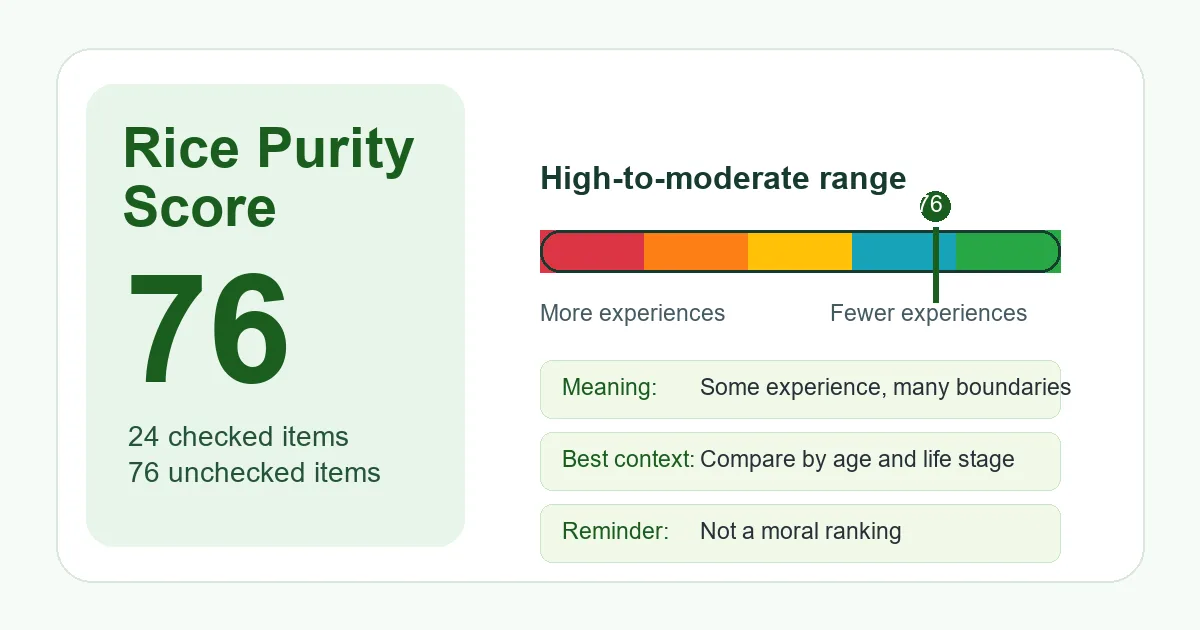
How the 76 score is calculated
The Rice Purity Test is usually scored with a simple formula: 100 minus the number of checked items. If your final result is 76, the math is straightforward.
For general background on purity tests as a college and internet culture format, see the overview of the Rice Purity Test. This page focuses on practical score interpretation rather than the test's full history.
| Score detail | What it means | How to read it |
|---|---|---|
| Final score | 76 out of 100 | Higher than many broad average estimates |
| Checked items | 24 items | Some experiences, not an extreme result |
| Unchecked items | 76 items | Many categories remain unexperienced |
| General range | High-to-moderate purity | Common around late teens or early college context |
If you want the broader scoring framework, compare this page with our Rice Purity Test score scale and score meaning guide. This article focuses only on the specific meaning of 76, so it does not replace those broader pages.
Is 76 a good Rice Purity score?
Yes, if by "good" you mean "normal and not concerning." But the more accurate answer is that Rice Purity scores are not good or bad. A score of 76 does not measure character, maturity, attractiveness, safety, intelligence, or relationship value. It only reflects which experiences you marked on a casual 100-item checklist.
For teens
A 76 may be lower than some peers but still within a believable range, especially for older teens with dating or party exposure.
For college students
A 76 often reads as fairly high. It may suggest some experiences but fewer than many college-age averages.
For adults
A 76 can be relatively high, but adults vary widely by values, culture, relationship history, and lifestyle.
The safest interpretation is: 76 is a balanced score with plenty of remaining boundaries. It does not suggest that something is wrong, and it should not be used to pressure yourself into changing your behavior.
What experiences usually lead to a 76?
The test does not reveal which items you checked, so no article can know your exact experience pattern. Still, a 76 usually means 24 checked boxes across one or more ordinary categories.
- Social experiences: parties, staying out late, or rule-testing moments.
- Romantic experiences: dating, kissing, or relationship milestones.
- Academic or school experiences: minor shortcuts, skipped classes, or social traditions.
- Boundary experiences: things you tried once, decided were not for you, or experienced in a specific context.
How 76 compares with nearby scores
Exact-score searches are popular because people want a personal answer, not just a wide range. Here is the practical difference between 76 and nearby results.
| Score | Checked items | Short interpretation |
|---|---|---|
| 80 | 20 | High score with limited listed experiences |
| 76 | 24 | High-moderate score with some experience |
| 70 | 30 | Closer to the broad college-age middle |
| 59 | 41 | Middle-lower result; see our 59 score guide |
| 55 | 45 | Moderate range with more checked items |
If your score is nearby but a little higher, compare it with our 77 Rice Purity score meaning guide. If it is a little lower, the 70 Rice Purity Test score meaning guide explains the boundary between high scores and the broad middle. If your score is much lower but not quite in the 45-55 band, the 59 Rice Purity score guide gives a focused middle-lower interpretation. If you want a broader chart across all numbers, use the Rice Purity Test score chart.
Should you compare a 76 score with friends?
Comparing scores can be funny when everyone treats it as a light conversation. It becomes unhealthy when people use the number to shame, rank, pressure, flirt aggressively, or decide whether someone is "innocent enough." A 76 can mean different things depending on age, culture, personal values, safety, and consent.
A healthier way to talk about it
- Share only if you actually want to share.
- Do not ask which exact items someone checked unless they offer.
- Avoid turning the score into a dare or competition.
- Use the score as a conversation starter, not a judgment.
For younger readers, it is also worth reading our Rice Purity Test for teens guide, which covers peer pressure and safer interpretation.
Common myths about a 76 Rice Purity score
FAQ about a 76 Rice Purity Test score
What does a 76 Rice Purity Test score mean?
It means you checked 24 of the 100 items. In plain English, that usually indicates some life experience while still leaving most listed experiences unchecked.
Is 76 high or low?
It is generally on the higher side compared with many broad online score ranges. It is not extremely high like 90+, but it is higher than the middle ranges around 50-69.
Is 76 normal for a teenager?
It can be normal, especially for older teenagers. For younger teens, context matters more, and the test should not be used as pressure to have more experiences.
Is 76 normal for college?
Yes. It may be a little higher than some college averages, but it is still completely plausible. College students vary widely depending on personality, culture, campus environment, and relationship history.
Should I retake the test if I got 76?
You can retake it for fun, but you do not need to chase a different number. The test is more useful when it helps you reflect calmly, not when it turns into a goal.
Bottom line
A 76 Rice Purity Test score means 24 checked items and 76 unchecked items. It usually suggests a high-to-moderate score: not untouched by experience, but still far from the lower-score ranges. The number can be interesting, but it should never be treated as a ranking of your worth or someone else's.
Next step
If you want to understand your result in a broader context, compare 76 with the full score scale or retake the test carefully.
Take the Rice Purity Test View Score Scale