Quick answer: is 77 a bad Rice Purity score?
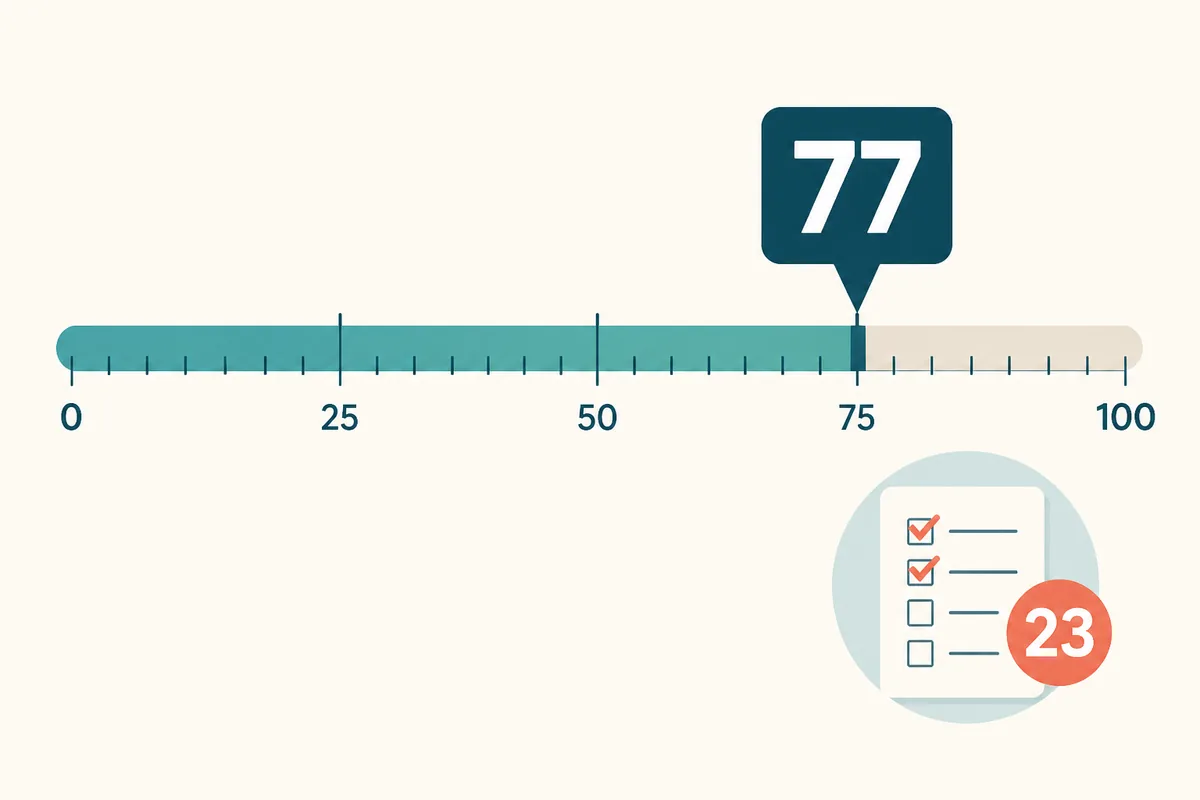
No. A 77 Rice Purity score is not automatically bad. The usual calculation means you checked 23 of the 100 listed experiences and left 77 unchecked. On a broad 0–100 scale, 77 is normally described as a high score with some experience, not an extreme result.
The number cannot tell anyone which items you checked, whether an experience was wanted, or what your personal boundaries are. That is why the most useful answer to “is 77 a bad Rice Purity score?” is: treat it as a private checklist result, not a moral label.
For readers searching for 77 Rice Purity score meaning, the practical interpretation is simply 23 checked items plus the context you bring to the result.
How a 77 score is calculated
The usual Rice Purity Test scoring method begins at 100. Each item that applies to you is checked, and the result is reduced by one point for each checked item. The math for 77 is therefore simple: 100 - 23 checked items = 77.
This calculation explains the number, but it does not explain the story behind it. Two people can both score 77 after checking completely different categories. The score is a count, not a detailed record of what happened.
| Score detail | What it means | How to read it |
|---|---|---|
| Final score | 77 out of 100 | High result on the broad scale |
| Checked items | 23 items | Some listed experiences apply |
| Unchecked items | 77 items | Most listed experiences do not apply |
| Best interpretation | Context-dependent | Age, consent, privacy, and values matter more than the label |
For the broader range framework, compare this exact-score guide with the Rice Purity Test score scale and the general score meaning guide. For public background on the checklist format, see the Rice Purity Test overview.
Is 77 a good, bad, or normal score?
People often use “good,” “bad,” and “normal” as shortcuts for a more personal question: “Should I be worried about my result?” A 77 can be a comfortable result, but the test does not provide a universal grading rubric.
Bad?
No. A lower or higher number is not proof that someone is good or bad. The checklist does not measure character.
Good?
If “good” means the result feels consistent with your choices and boundaries, 77 may feel fine. That is a personal reading.
Normal?
There is no required normal score. People at the same age, school, or life stage can have very different results.
A 77 result is usually closer to the high end than the middle of the scale. That can be a useful description, but it should not become pressure to keep the number high or to lower it for social approval. You do not need to change your behavior to produce a more impressive score.
How 77 compares with nearby Rice Purity scores
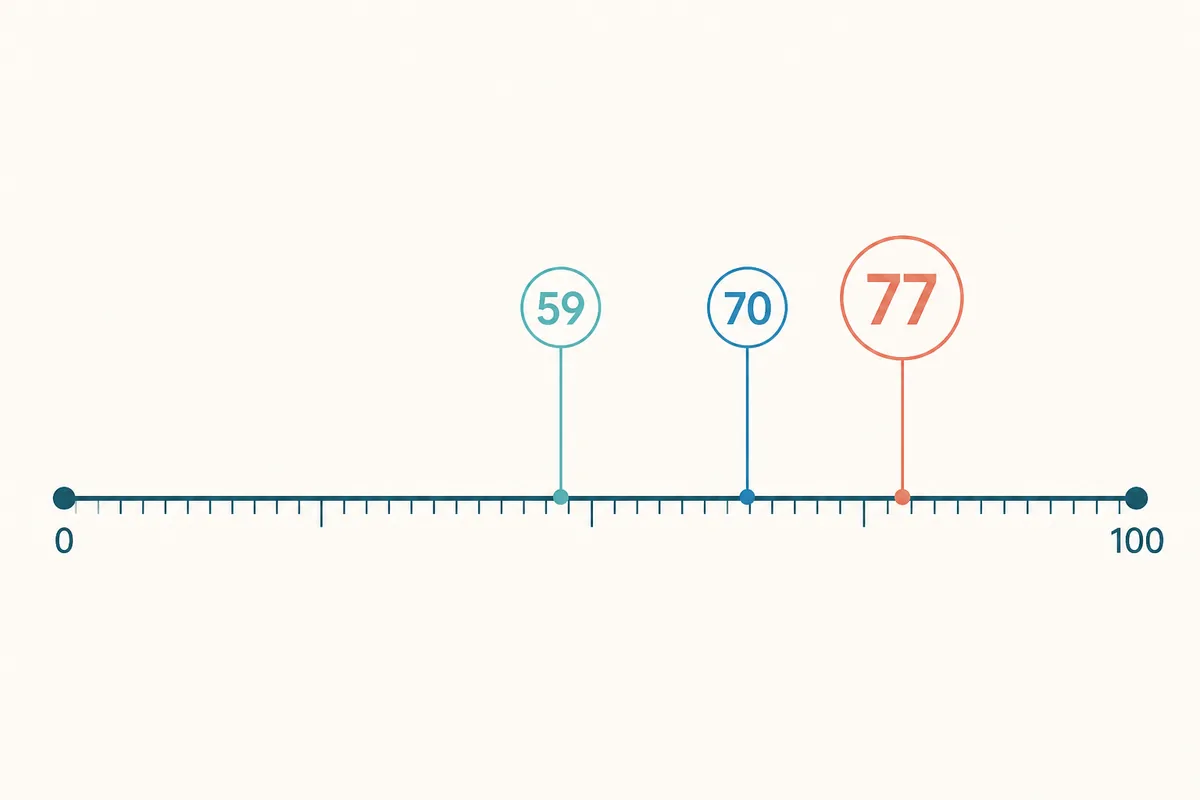
Exact-score searches are different from broad score-range searches. If you are looking at 77, the nearby numbers help show what changes and what does not. Every one-point change represents one additional checked or unchecked item; it does not automatically represent a major change in life experience.
| Score | Checked items | Practical reading |
|---|---|---|
| 80 | 20 | High score with fewer listed experiences |
| 77 | 23 | High result with some checked experiences |
| 76 | 24 | One more checked item than 77; see the 76 score guide |
| 70 | 30 | More checked items; see the 70 score guide |
| 59 | 41 | Middle-lower comparison point; see the 59 score guide |
If you want a complete chart rather than one exact result, use the Rice Purity Test score chart. If you are comparing your result with an average, read the average score guide carefully: reported averages are context clues, not a target that every person should reach.
How age and life stage change the context
Age can change how a 77 result feels, but age does not turn it into a pass or fail. A younger reader may be more concerned about privacy and age-appropriate content. A college-age reader may be comparing scores with friends. An adult may be revisiting the test for nostalgia or conversation. The same number can be read differently in each setting.
| Life stage | What 77 may prompt | Healthier question to ask |
|---|---|---|
| Teen years | Concern about peer comparison, privacy, or mature questions | Did I choose what to share, and do I feel safe? |
| College transition | Curiosity about whether the number is common among friends | Can I treat this as a conversation game rather than a ranking? |
| Adulthood | Reflection on how experiences and values have changed | Does the checklist actually help me reflect, or is it just entertainment? |
For teen-focused privacy and safety guidance, see the Rice Purity Test for teens page. The important boundary is voluntary participation: no one should be pushed to complete mature questions, reveal private answers, or justify a score.
Why two people can both score 77
The final number hides the distribution of checked items. One person might check mostly social or dating prompts; another might check school, rule-testing, substance-related, or other categories. The same total can therefore describe very different lives.
- The score does not identify the checked items. A result page should not be treated as a public record of someone’s experiences.
- The score does not measure consent or safety. If an experience was pressured or unwanted, the number is not the important part of the story.
- The score does not predict future behavior. A 77 today is only a snapshot of the answers you gave today.
- The score does not measure maturity. Life experience, judgment, kindness, and boundaries are not the same thing as the number on a checklist.
Should you share a 77 score with friends?
Only share it when you actually want to. Friends may treat purity tests as a light conversation starter, but the interaction stops being light when someone demands a screenshot, asks for every checked item, or uses the score to rank or tease people.
A safer way to compare
- Share the number only, without explaining private details.
- Say “I would rather not discuss the questions” if someone presses for more.
- Do not use the score as a dare, dating filter, or proof of maturity.
- Keep the result private if a group conversation feels uncomfortable.
If the result brings up an unwanted or unsafe memory, talk to someone you trust rather than trying to change the number. Your well-being matters more than the score.
FAQ about a 77 Rice Purity score
What does a 77 Rice Purity score mean?
A 77 score means you checked 23 of the 100 listed items and left 77 unchecked. It is generally a high result on the broad scale, but it is not a personality label.
Is 77 a bad Rice Purity score?
No. There is no universal bad Rice Purity score. A 77 usually means some items applied to you, not that your choices or character are bad.
Is 77 a good Rice Purity score?
It can be a normal and comfortable result, but “good” is not a meaningful official category. The useful question is whether the result fits your own boundaries and whether you feel safe sharing it.
How many items did I check if my score is 77?
You checked 23 items. The usual calculation is 100 minus checked items, so 100 - 23 = 77.
Is 77 high or low on the Rice Purity Test?
77 is normally closer to the high end of the 0–100 scale than to the middle or low end. That describes the number of checked items; it does not rank the person who received it.
Is a 77 Rice Purity score normal at 18?
It can be a believable result at 18, but there is no required normal score. People at the same age can have different experiences, values, and reasons for taking the test.
Should I retake the test to get a higher score?
Retake it only if you want to reflect or compare answers over time. Do not retake it because someone says a higher number is more impressive. A score is not a goal.
Sources and context
This page explains how to read a 77 result; it is not an official grading rubric or a scientific diagnosis. The public Rice Purity Test overview is useful for basic historical and format context, while our average-score guide and score chart explain why broad comparisons should be treated cautiously.
Bottom line
A 77 Rice Purity score means 23 checked items and 77 unchecked items. It is usually a high result, but it is not bad, good, or normal in a universal sense. Read it as a private snapshot, keep the details yours, and use age, consent, safety, and personal values as the real context.
Choose your next step
If you want to see the full checklist, take the test privately. If you already have a result, compare it with the broader scale without turning it into a ranking.
Take the Rice Purity Test View Score Scale