Quick answer: what does a 62 Rice Purity score mean?
A score of 62 means 38 “yes” answers and 62 “no” answers on the standard 100-item test. It usually lands in the broad middle of the scale: more listed experiences than someone scoring 70, but slightly fewer than someone scoring 59.
The number cannot tell you which items were checked. Two people can both score 62 after choosing completely different experiences, so the story behind the result matters more than the category label.

How a 62 Rice Purity Test score is calculated
The usual scoring rule starts at 100 and subtracts one point for each checked statement. There are no weighted questions in that basic method.
| Step | Calculation | Result for 62 |
|---|---|---|
| Start | Begin with 100 points | 100 |
| Subtract | 100 − final score | 100 − 62 = 38 |
| Interpret | Count checked and unchecked items | 38 checked, 62 unchecked |
This explains the math but not the meaning of individual answers. For the broader framework, use the 0–100 score scale; for a general explanation of the scoring system, read the Rice Purity Test score meaning guide.
Is 62 a good Rice Purity score?
There is no official pass mark or morally “good” result. Calling 62 good, bad, high, or low usually reflects the observer’s expectations—not a rule built into the test. A more useful description is middle range with 38 listed experiences checked.
Good?
Not objectively. The test does not measure kindness, judgment, health, or maturity.
Normal?
Possible for many life stages, but a quiz cannot define what is normal for one person.
Concerning?
The number alone is not. Specific unwanted or unsafe experiences may deserve attention.
How 62 compares with nearby Rice Purity scores
A few points can look important on a 0–100 scale, but nearby results mostly change the checked-item count. They do not create a sharp boundary between “innocent” and “experienced.”
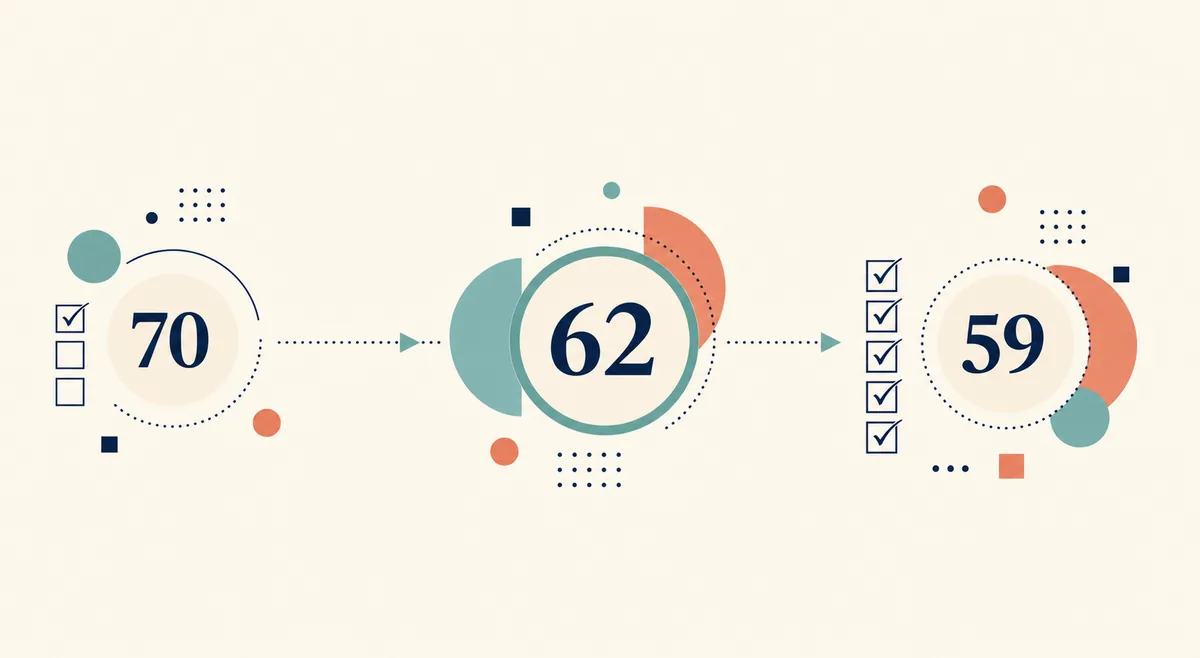
| Score | Checked items | Simple comparison | Focused guide |
|---|---|---|---|
| 70 | 30 | 8 fewer checked items than 62 | 70 score meaning |
| 62 | 38 | The score explained on this page | Current guide |
| 59 | 41 | 3 more checked items than 62 | 59 score meaning |
What a score of 62 can and cannot tell you
It can tell you the total
The score reliably summarizes how many statements were left unchecked under the standard formula. It can also help you locate the result on a broad range chart.
It cannot identify the experiences
Thirty-eight checked items could come from dating, school, parties, substances, legal trouble, or several other categories. The same total can represent very different lives.
It cannot measure safety or consent
A total score does not distinguish a comfortable choice from pressure, coercion, regret, or an event that felt unsafe. If one answer still troubles you, focus on that experience and seek support from someone trustworthy rather than debating whether 62 is “good.”
Is a 62 Rice Purity score normal for your age?
Age changes how people interpret a result, but there is no verified universal age table. Online averages are usually self-reported, shaped by who chose to take the quiz, and not a scientific standard. Use the average Rice Purity score by age only as broad entertainment context.
- Younger teens: explicit items may be developmentally inappropriate, and privacy and safety should come first.
- Older teens and college-age users: a 62 may reflect a mix of relationships, social experiences, and growing independence, but no one owes friends an explanation.
- Adults: the list may omit major life experiences while overemphasizing others, so comparisons often become less useful.
If you are under 18, use the site’s teen-focused guidance and avoid sharing answers publicly. A number is never a reason to rush into an experience or hide something unsafe.
A healthier way to read a 62 result
- Check the math: 62 means 38 checked items.
- Skip the ranking: do not use the result to label yourself or someone else.
- Notice patterns: consider which categories account for most answers.
- Protect details: share only what you freely choose to share.
- Prioritize safety: unwanted, illegal, risky, or distressing experiences matter more than the final number.
FAQ about a 62 Rice Purity score
What does a 62 Rice Purity score mean?
It means 38 of 100 items were checked and 62 were left unchecked. The result is best described as middle range, with the exact meaning depending on which experiences apply.
Is 62 a good Rice Purity score?
There is no official good or bad score. Sixty-two reflects a total, not morality, health, maturity, or personal worth.
Is a 62 Rice Purity score normal at 18?
It can occur at 18, but one self-reported quiz score cannot define normal. Personal boundaries, consent, safety, and the experiences behind the number matter more.
Is 62 considered low?
It is lower than scores in the 70s or 80s and higher than scores in the 40s or 50s. Most broad charts place it in a middle band rather than at either extreme.
How many questions did I answer yes to?
Thirty-eight. Subtract the score from 100: 100 − 62 = 38.
Should I retake the test to get a better score?
Retake it only to correct mistaken answers or reflect later—not to chase a “better” number. The score is not a goal.
Bottom line
A 62 Rice Purity score means 38 checked experiences. It is a middle-range snapshot, not evidence that someone is good, bad, normal, mature, or safe. Use it for private reflection, compare only with caution, and give more weight to consent, comfort, and real-life context than to the number.
Choose your next step
Review the full scale for broad context or take the standard test privately.
View Score ScaleTake the TestReference note
The Rice University archive includes historical purity-test material from the 1990s. See the Rice University Archives record. This page does not treat the quiz as a clinical or scientific assessment.