Quick answer: what score is considered good?
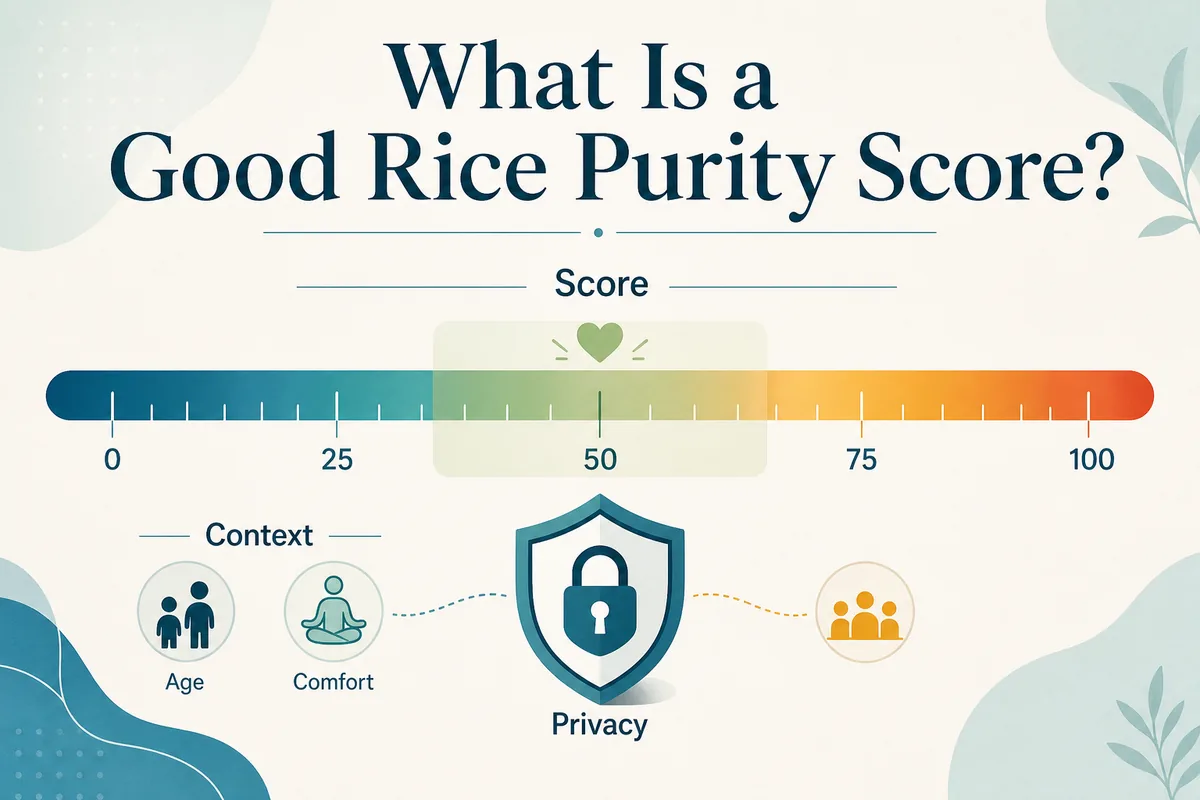
There is no official good Rice Purity score. The test is a private checklist, not a grading system. A higher score usually means fewer listed experiences apply to you, so many people casually read a score in the 80s or 90s as "very pure" and a score in the 70s as still high-to-middle.
The healthier interpretation is simpler: a good score is one you can understand honestly without using it to shame yourself, impress friends, or pressure someone else. For the math behind any result, compare this page with our broader Rice Purity Test score meaning guide.
How the score works before you label it good
The standard Rice Purity Test is usually scored from 0 to 100. You start at 100 and subtract one point for each prompt that applies to you. That means a score of 92 usually means 8 checked items, 76 means 24 checked items, 70 means 30 checked items, and 45 means 55 checked items.
That math matters because "good" can be a vague social label. If someone says 90 is good, they usually mean the person checked very few experiences. If someone says 60 is normal, they usually mean many people land near the broad middle. Neither statement tells the full story.
For background context, the Rice Purity Test is commonly presented as a voluntary social checklist on the Rice Purity Test site, and Rice University's archive records preserve related historical test materials. For consent language used in this guide, see RAINN's plain-language page on what consent means.
| Score range | Common casual label | Checked-item math | Better way to read it |
|---|---|---|---|
| 90-100 | Very high / very pure | 0-10 checked items | Often common for younger users or people with more private boundaries. |
| 70-89 | High to moderately high | 11-30 checked items | Many people still call this a good or normal score, especially outside college-age comparison. |
| 50-69 | Middle / average-ish | 31-50 checked items | A broad middle band where age and environment matter more than the label. |
| 30-49 | Low | 51-70 checked items | More listed experiences apply, but the number still does not measure worth or safety. |
| 0-29 | Very low | 71-100 checked items | Read carefully, especially if any checked item involved pressure, risk, or regret. |
Is a high Rice Purity score good?
A high score can be good in the simple sense that it often reflects fewer listed experiences, more privacy, or a slower personal timeline. It can also feel reassuring for readers who are worried that they are "behind" or different from friends.
But a high score should not become a superiority label. The score does not know whether a person is kind, emotionally mature, careful, honest, or safe. It also does not know whether someone avoided experiences because of personal values, family rules, lack of opportunity, anxiety, religion, culture, or simple preference.
If your score is high, the useful takeaway is not "I am better." It is "many prompts do not apply to me yet, and that is okay." If your score is lower, the useful takeaway is not "I failed." It is "more prompts apply to me, and I can still read them with context."
Good score by age and life stage
Age changes the meaning of almost every score. A number that feels low for a 14-year-old may be ordinary for a college student. A number that feels high in one friend group may be average in another. That is why exact cutoffs are less useful than age-aware ranges.
| Age or stage | What may feel like a good score | Why context matters | Helpful next page |
|---|---|---|---|
| 13-15 | Usually higher scores, often 80+ | Privacy, boundaries, and age-appropriate interpretation matter more than comparison. | 15-year-old guide |
| 16-18 | Often high-to-middle, depending on social environment | Scores spread out more as dating, parties, and peer pressure vary widely. | 17-year-old guide |
| College age | Middle scores may feel normal | College culture can change opportunities and social comparison quickly. | Average score guide |
| Adults | No single useful benchmark | More years of life naturally create more chances for checked items. | Score scale |
Good, normal, high, and low are not the same thing
People often mix four different ideas: good, normal, high, and low. A high score is about the number. A normal score is about how common it seems in a group. A good score is a value judgment. A low score is also just a number until you know the story behind it.
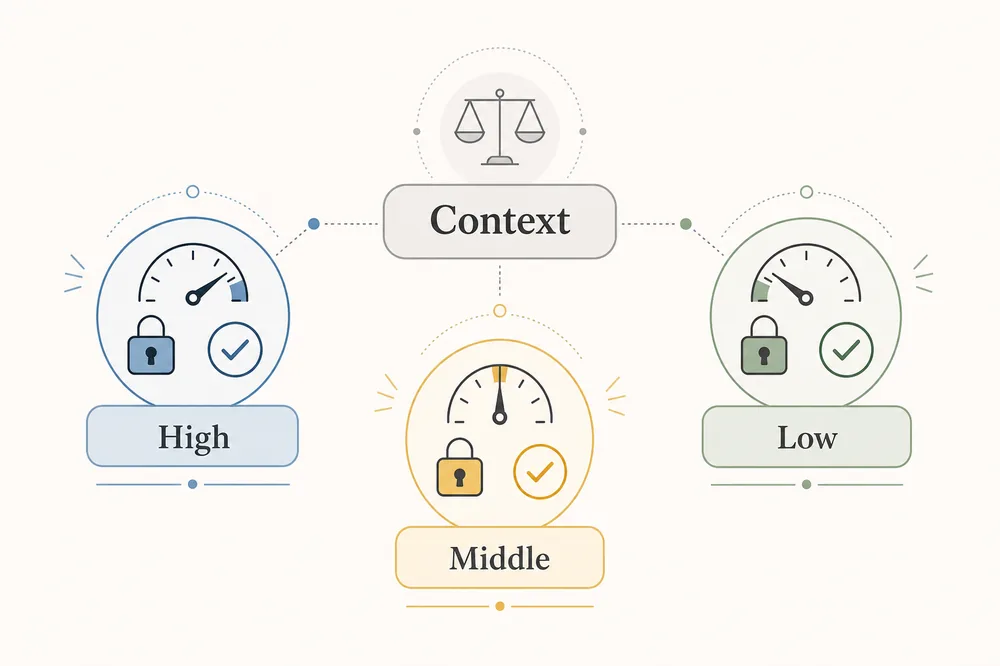
High score
Fewer listed experiences apply. This may be common for younger readers or people with more private boundaries.
Normal score
A score that fits your age, values, environment, and comfort level without forcing comparison.
Good score
A score you can understand honestly while keeping privacy, consent, and safety at the center.
When a "good" score question is really about worry
Many searches for a good Rice Purity score are not really asking for a number. They are asking, "Am I normal?" or "Will people judge me?" or "Did I answer too many questions yes?" Those are different concerns, and they deserve a calmer answer than a score cutoff.
If your concern is social comparison, keep the score private and use it only for reflection. If your concern is safety, focus on the circumstances behind checked items instead of the final number. If your concern is a specific score, use exact-score guides where available, such as 70 Rice Purity score meaning, 76 score meaning, or 59 score meaning.
How to read your own score without overreacting
- Convert the number. Subtract your score from 100 to estimate checked items.
- Place it in a broad range. Use the score scale for quick orientation.
- Add age context. A score means different things at 14, 18, 22, and 30.
- Look for patterns. A cluster of risky or unwanted items matters more than the final score.
- Protect privacy. You do not owe anyone your score or checked-item details.
FAQ
What is a good Rice Purity score?
There is no universal good score. Many people casually treat 80-100 as high or very pure and 70-79 as still high-to-middle, but the better answer depends on age, privacy, safety, and personal values.
Is a high Rice Purity score good?
A high score means fewer listed experiences apply. That can be perfectly normal and comfortable, but it should not be used to rank people or shame lower scores.
Is 70 a good Rice Purity score?
A 70 means about 30 checked items. Many people read it as a high-to-middle score, especially for older teens or young adults. For a deeper answer, read our 70 score guide.
Is 50 a good Rice Purity score?
A 50 means half the list applies and half does not. It is not automatically good or bad. It needs age, life stage, and the story behind the checked items.
Should I try to get a better Rice Purity score?
No. The test is not a goal or challenge. Do not make real-life choices to raise or lower a quiz score. Use it as private reflection, not a plan.
Bottom line
A good Rice Purity score is not a single number. A higher score usually means fewer checked experiences, but good interpretation depends on context. The score should help you reflect privately, not rank yourself against friends.
If you want the broad math, use the Rice Purity score scale. If you are worried your number is bad, read what counts as a bad Rice Purity Test score. If you want to take the test again privately, use the official Rice Purity Test.
Next step
Start with the full score scale, then compare only if the comparison is relevant to your age and situation.
View Score Scale Take the Test