Rice Purity Test for 15 Year Olds: Average Score, Safety, and What It Means
The short answer: a 15-year-old should treat the Rice Purity Test as a private reflection activity, not a challenge, scoreboard, or dare. A high score is very normal at 15, a lower score is not a moral label, and the healthiest interpretation depends on privacy, consent, maturity, and whether anyone is pressuring you to share or compare.
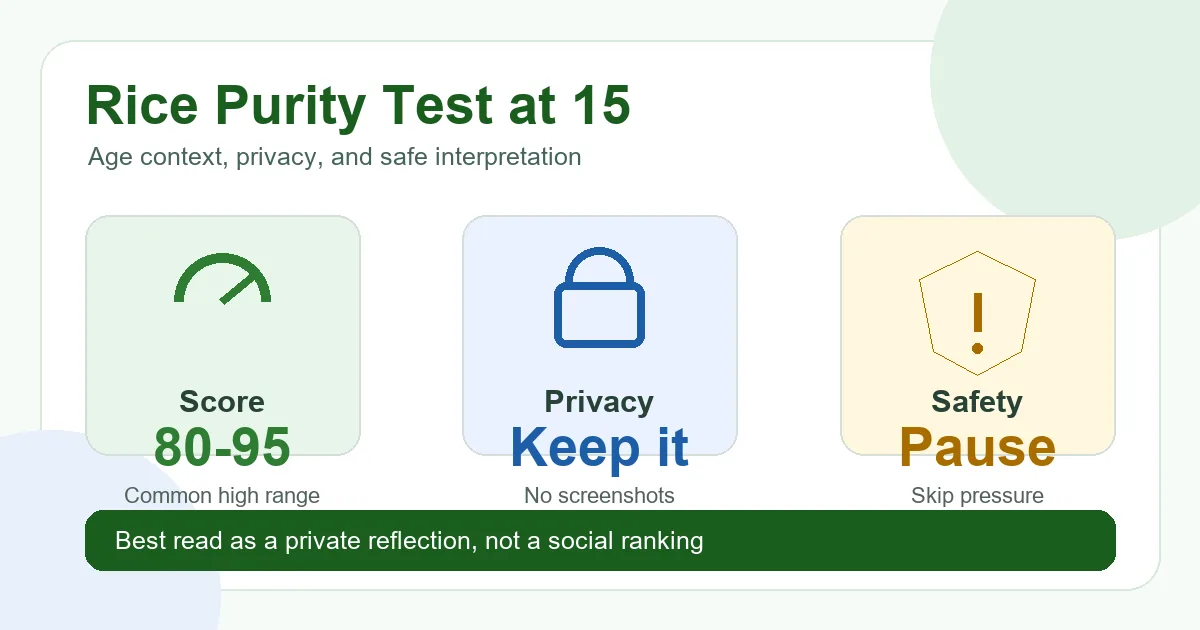
Quick Answer: Should 15-Year-Olds Take the Rice Purity Test?
The Rice Purity Test for 15 year olds is usually searched by teens who want to know whether their score is normal, whether the test is too mature, and whether they should compare results with friends. The safest answer is conditional: it can be okay for some 15-year-olds when it is optional, private, and understood as a checklist of life experiences rather than a measure of worth.
The standard test includes mature questions about relationships, parties, substances, rule-breaking, and sexual experiences. If you are 15, you do not need to answer every question, share your score, or prove anything. If any item feels confusing, uncomfortable, or connected to pressure, stopping is a good choice.
What Is a Normal Rice Purity Score at 15?
There is no official universal average Rice Purity score for 15 year olds. Search results often show exact-looking numbers, but those figures usually come from self-reported online audiences, not balanced research. A more honest approach is to use broad score ranges as context and avoid treating one number as a rule.
For many 15-year-olds, a score somewhere in the 80 to 95 range can be completely ordinary. Scores above 90 often mean very few checklist items apply so far. Scores in the 80s may reflect some dating, social, or online experiences while still being high. A lower score does not define someone, but it is worth asking whether the experiences behind it were safe, wanted, and age-appropriate.
| Score range | Plain-English meaning for 15-year-olds | How to read it safely |
|---|---|---|
| 95-100 | Very few listed experiences apply. | Extremely normal at 15. It does not mean you are behind. |
| 90-94 | High score with limited teen experiences. | Common for teens with cautious boundaries or limited dating exposure. |
| 80-89 | High-to-moderate score with some social or dating items. | Read in context: friend group, family rules, maturity, and comfort level matter. |
| 70-79 | More listed experiences than many younger teens report. | Not automatically bad, but a useful moment to reflect on consent, pressure, and safety. |
| Below 70 | A broader set of checklist items applies. | The number is not a judgment. If any item involved pressure, harm, or regret, talk to a trusted adult or support resource. |
15 vs 14, 16, and General Teen Scores
Age-specific context matters because a score can mean different things at different stages. A score of 88 may be common for one 15-year-old friend group, high for another, and very different from what you might expect from a 13-year-old. That is why this page answers the age-15 query directly while leaving broader benchmarking to the average Rice Purity score guide.
| Age / page | Expected pattern | Best next step |
|---|---|---|
| 13-year-olds | Very high scores are expected and mature items need extra care. | Use parent-friendly guidance and avoid mature pressure. |
| 14-year-olds | Scores may begin to vary, but high scores are still common. | Keep the test educational, private, and age-aware. |
| 15-year-olds | Scores spread more as dating, online culture, parties, and friend groups vary. | Interpret privately and focus on boundaries instead of matching peers. |
| 16-year-olds | Scores can vary further because independence and social situations differ. | Use safety, consent, and peer-pressure context. |
| Teen version | Best general entry point for teen-safe framing. | Start there if you want broader teen guidance before taking the standard test. |
How to Interpret a 15-Year-Old's Score Without Shame or Pressure
The Rice Purity score is a checklist result. It is not a measure of maturity, kindness, popularity, confidence, intelligence, or whether someone is "good." A high score usually means fewer listed experiences apply so far. A lower score means more items apply. Neither result explains whether those experiences were wanted, safe, respectful, or emotionally healthy.
If your score is higher than your friends' scores, you are not late. If your score is lower, you are not ruined. The useful question is not "What number should I have?" The useful question is "Do I feel safe, respected, and in control of the choices behind this number?"
If your main concern is the number itself, use the Rice Purity Test score meaning guide or the score chart. This page keeps the focus on the age-15 context so it does not compete with the broader score pages.
Privacy and Peer Pressure Rules for 15-Year-Olds
For 15-year-olds, the biggest risk is often not the score itself. It is the social setting around the score: group chats, screenshots, sleepovers, dares, comparison videos, and friends asking for proof. A private quiz can become uncomfortable quickly when people treat the result as gossip.
Safer use
- You choose to take it privately and voluntarily.
- You understand the score is not a moral ranking.
- You skip questions that feel too personal.
- You keep your score out of screenshots and public posts.
Red flags
- Someone demands your score as proof of maturity.
- Friends rank, tease, or shame people by score.
- You feel pushed to lower your score on purpose.
- A question reminds you of pressure, coercion, or harm.
For broader youth online-safety guidance, readers can review NCMEC NetSmartz. For background on the test's campus origins, Rice University archival materials preserve purity-test documents, including records in the Rice archives.
Parents and Guardians: What to Do If a 15-Year-Old Asks About the Test
If you are a parent or guardian, the most useful first response is calm curiosity. A 15-year-old may have found the test through TikTok, a friend group, a search result, or an older sibling. Treating the topic as forbidden can make the teen hide questions; treating it as a normal conversation can make room for boundaries and safety.
Ask what made them interested. Was it curiosity, a group chat, a friend comparison, or worry about a specific question? Those situations call for different responses. Curiosity may need context. Pressure may need help saying no. Worry may need reassurance and a safe adult response.
A practical script: "You do not have to show me your score. I want you to know that a checklist does not define you. If any question makes you uncomfortable or reminds you of something that did not feel okay, you can talk to me or another trusted adult without getting in trouble."
Should a 15-Year-Old Use the Teen Version or the Official Test?
Most 15-year-olds should start with the teen-focused Rice Purity Test page because it frames the experience around privacy, boundaries, and age context. The official Rice Purity Test is useful when someone wants the standard 100-question experience, but it includes mature prompts and should be approached thoughtfully.
This article does not replace the teen page, the official test, or the average-score guide. It answers one narrower question: what the Rice Purity Test means at 15, especially when someone wants an age-specific score range and safety context.
Frequently Asked Questions
Final Takeaway
The best way to read the Rice Purity Test at 15 is with context. A high score is common. A lower score is not a judgment. The number becomes useful only when paired with privacy, consent, emotional readiness, and personal boundaries.
If you want to take the test, start with the teen-focused version. If you already have a number, compare it gently with score guides instead of treating it like a scoreboard.
Go to Teen Guide Take the Official Test