Rice Purity Test for 16 Year Olds: Average Score, Safety, and What It Means
The short answer: many 16-year-olds can take the Rice Purity Test as a private, optional reflection activity, but it should not become a competition, a dare, or a reason to feel behind. At 16, a high score is common, a changing score is normal, and the healthiest interpretation depends on context.
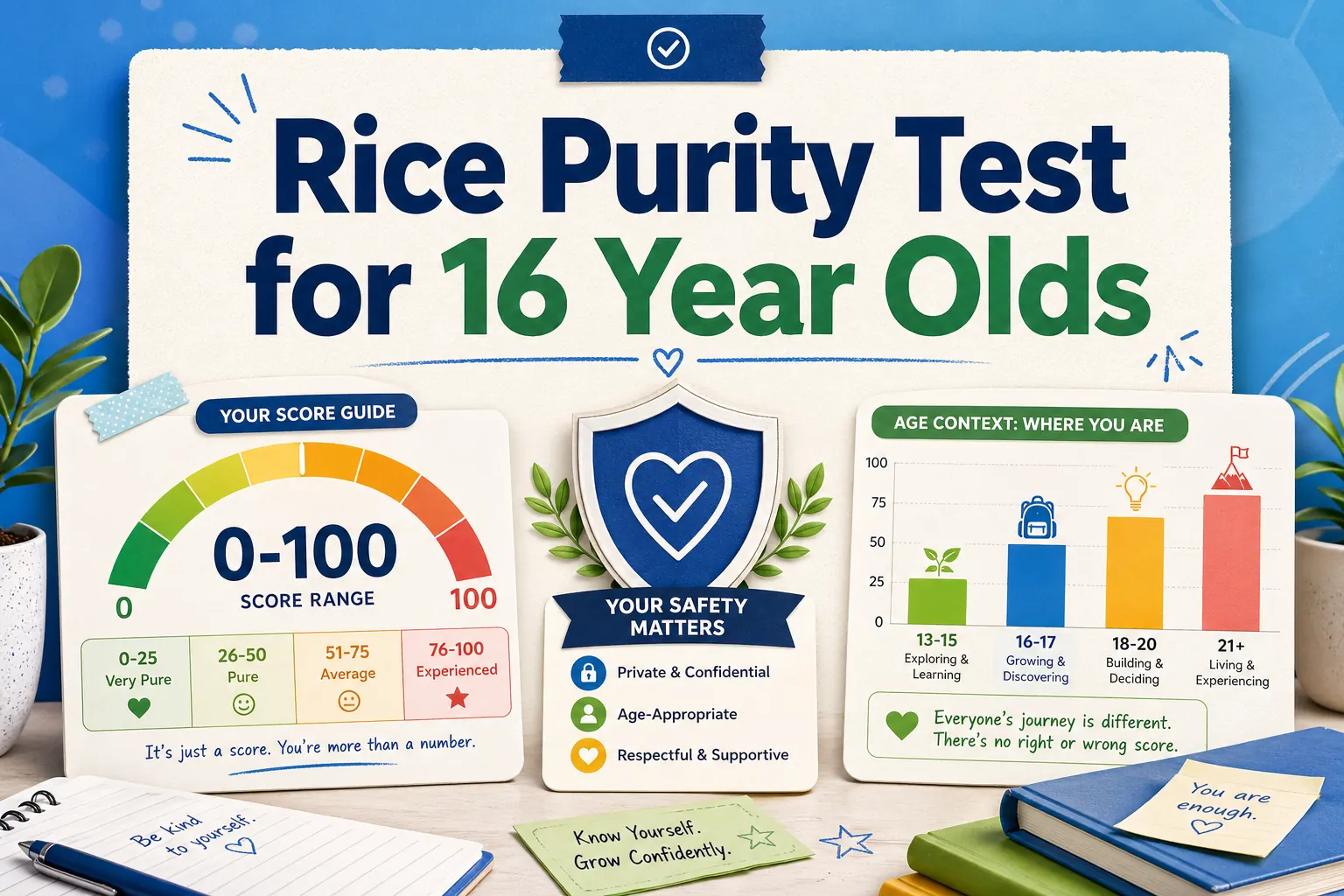
Quick Answer: Should 16-Year-Olds Take the Rice Purity Test?
The Rice Purity Test for 16 year olds is usually searched by teens who want to know whether their score is normal, and by parents who want to know whether the test is appropriate. The balanced answer is: it can be okay for some 16-year-olds if it is handled privately, thoughtfully, and without pressure. The standard Rice Purity Test includes mature topics, so it is not the same as a simple personality quiz.
For a 16-year-old, the best use of the test is not to prove maturity. It is to understand boundaries, notice peer pressure, and put social comparison in perspective. If any question feels confusing, upsetting, or too personal, skipping the test is a completely reasonable choice.
What Is a Normal Rice Purity Score at 16?
There is no official universal average Rice Purity score for 16 year olds. Search results often give exact-looking numbers, but those numbers usually come from informal web audiences, not controlled research samples. A better approach is to use score ranges as practical context rather than treating one number as the truth.
For many 16-year-olds, a score somewhere in the 70 to 90 range can be very normal. Some will score higher, especially if they have had fewer dating, party, or risk-taking experiences. Some will score lower because of their social environment, personal timeline, or earlier exposure to mature situations. The score alone does not explain whether those experiences were healthy, wanted, safe, or age-appropriate.
| Score range | Plain-English meaning for 16-year-olds | How to read it safely |
|---|---|---|
| 90-100 | Very few listed experiences apply. | Common and healthy at 16. There is no need to rush into experiences to lower the score. |
| 80-89 | High score with some typical teen experiences. | Often normal for teens who are social but still cautious or selective. |
| 70-79 | Moderate-high score with a wider range of experiences. | Worth reading in context: friend group, family rules, dating history, and personal comfort matter. |
| 60-69 | More experiences than many younger teens report. | Not automatically bad, but it may be useful to reflect on safety, consent, pressure, and boundaries. |
| Below 60 | A broad set of listed experiences applies. | The number is not a judgment. If any experience involved pressure, harm, or regret, talk with a trusted adult or support resource. |
16 vs 13, 14, and General Teen Scores
Age matters because the same score can mean different things at different stages. A score of 82 may look ordinary for a 16-year-old, high for a college student, and very different from what you might expect for a 13-year-old. That is why this page avoids competing with our broader Rice Purity Test for teens page. The teens page is the general testing hub; this article focuses on age-16 interpretation.
| Age / page | Expected pattern | Best next step |
|---|---|---|
| 13-year-olds | Very high scores are expected and usually ordinary. | Use parent-friendly guidance and avoid mature pressure. |
| 14-year-olds | Scores may begin to vary, but high scores are still common. | Keep the test educational and age-aware. |
| 16-year-olds | Scores spread more because dating, parties, independence, and online culture vary widely. | Interpret privately, avoid score competition, and focus on boundaries. |
| Average score guide | Useful for broad context, but not a teen-specific rulebook. | Use it as a benchmark, not as proof that a score is good or bad. |
How to Interpret a 16-Year-Old's Rice Purity Score Without Overreacting
The most important thing to understand is that the test measures listed experiences, not character. A high score does not make someone better, and a lower score does not make someone worse. A Rice Purity score can hint at how much of the checklist applies, but it cannot tell whether a person is kind, careful, mature, emotionally ready, or safe.
If you are 16 and your score is higher than your friends' scores, that does not mean you are behind. It may mean you have different boundaries, different family expectations, different opportunities, or simply a different timeline. If your score is lower than expected, that also does not define you. The useful question is whether your experiences match your values and whether you felt safe, respected, and in control.
If the score raises questions about a specific number band, our Rice Purity Test score meaning guide and score chart give broader context. This page keeps the focus on age 16 because teenage comparison can easily distort what is actually normal.
Safety Notes for 16-Year-Olds
The Rice Purity Test includes questions about dating, parties, substances, rule-breaking, and sexual topics. For a 16-year-old, those categories can overlap with real safety concerns. The point is not to panic. The point is to treat the test as a prompt for reflection rather than entertainment without boundaries.
Green-light use
- You are taking it privately and voluntarily.
- You understand it is not a measure of worth.
- You can skip questions that feel uncomfortable.
- You are not using it to pressure someone else.
Red flags
- Friends are demanding screenshots or proof.
- The score makes you feel ashamed or panicked.
- Questions remind you of pressure, coercion, or harm.
- You feel pushed to lower your score on purpose.
For safety-focused background, readers can review youth online safety guidance from organizations such as NCMEC NetSmartz. For historical context on the test itself, Rice University archival materials show purity-test documents as part of campus culture, including items preserved in the Rice archives.
Parent and Guardian Notes
If you are a parent searching this topic, the main issue is not whether every 16-year-old must avoid the test. The better question is whether your teen can handle mature prompts without shame, secrecy, or social pressure. A calm conversation is usually more useful than a blanket reaction.
Start by asking what made them interested in the test. Was it curiosity, TikTok, friends, a group chat, or a classmate comparison? The answer changes the conversation. A teen who is simply curious may need context. A teen who feels pressured may need support setting boundaries. A teen who is upset by a question may need reassurance and a safe adult response.
A practical parent script might sound like this: "You do not have to share your score with me, but I want you to know the test does not define you. If any question makes you uncomfortable or reminds you of something that did not feel okay, you can talk to me or another trusted adult without getting in trouble."
Should a 16-Year-Old Use the Official Test or the Teen Version?
For most readers, the best path is to start with the teen-focused context first. The teen version helps frame the test around safety and age-appropriate interpretation. The official Rice Purity Test is useful when someone wants the standard experience, but it should be approached with awareness that some prompts are mature.
This article is not trying to replace either page. It is a bridge for a very specific search intent: people asking what the Rice Purity Test means at 16. That makes it easier for the site to serve the age-specific query without diluting the broader teens page or the official test page.
Frequently Asked Questions
Final Takeaway
The best way to read the Rice Purity Test at 16 is with context. A high score is common. A lower score is not a character judgment. The number is only a checklist summary, and it becomes useful only when paired with age, consent, personal boundaries, safety, and emotional readiness.
If you want to take the test, start with the teen-focused version and treat the result as private. If you want to understand your number afterward, use the score meaning and average score guides as context, not as a scoreboard.
Go to Teen Guide Take the Official Test