Rice Purity Test for 17 Year Olds: Average Score, Safety, and What It Means
The short answer: a 17-year-old can usually treat the Rice Purity Test as a private reflection activity, not as proof of maturity. A high score is still very normal at 17, a lower score is not a moral failure, and the safest interpretation depends on consent, privacy, peer pressure, and life context.
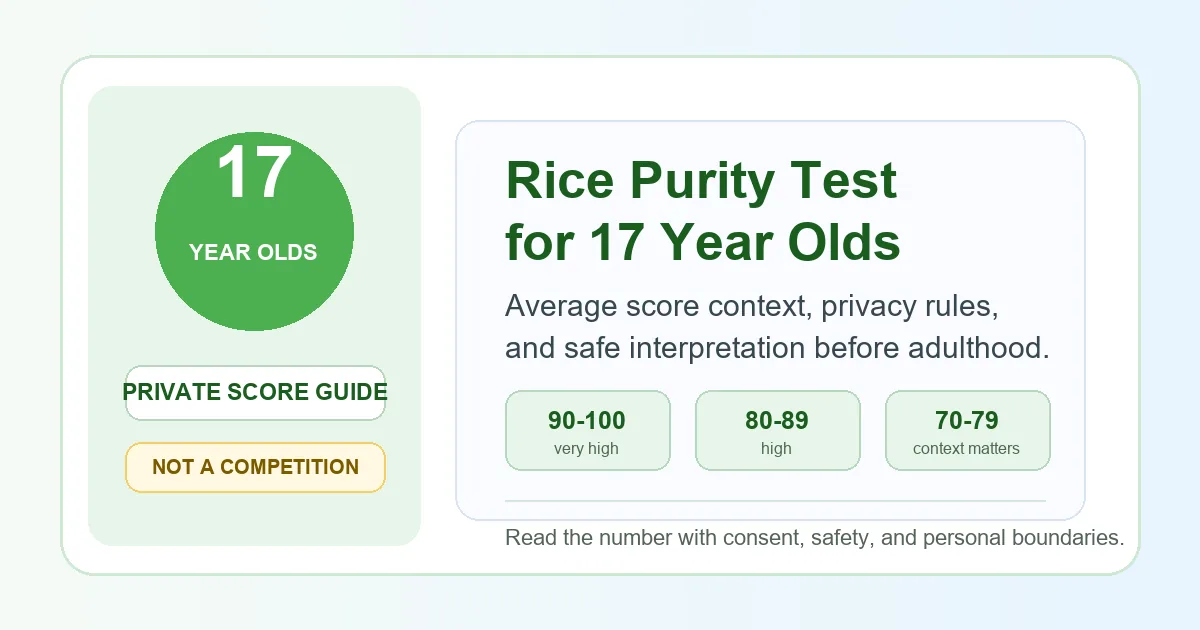
Quick Answer: Should 17-Year-Olds Take the Rice Purity Test?
The Rice Purity Test for 17 year olds is usually searched by students who are close to adulthood, planning for college, or comparing scores with friends online. The test can be fine as a private, optional checklist, but it becomes unhealthy when it turns into a dare, a screenshot challenge, or a way to judge someone's dating or social history.
The standard test includes mature topics around relationships, parties, substances, rule-breaking, and sexual experience. If you are 17, you are old enough to understand more of the context than a younger teen, but you still do not owe anyone a score, an explanation, or proof. Treat the result as personal information.
What Is a Normal Rice Purity Score at 17?
There is no official universal average Rice Purity score for 17 year olds. Online averages are usually self-reported, and the people who post their scores are not a balanced sample of every 17-year-old. Some competitor pages group 16-17-year-olds into broad ranges such as the mid-70s to high-80s, while other teen-score pages place teenagers even higher. Use those figures as rough context, not a rule.
For many 17-year-olds, a score somewhere in the 75 to 92 range can be completely ordinary. A score above 90 often means very few listed experiences apply. A score in the 70s may reflect more dating, social, or party exposure than some peers. A lower score is not automatically bad, but it is worth reading with safety, consent, and emotional readiness in mind.
| Score range | Plain-English meaning for 17-year-olds | How to read it safely |
|---|---|---|
| 90-100 | Very few listed experiences apply. | Very normal at 17. It does not mean you are behind, sheltered, or doing anything wrong. |
| 80-89 | High score with some ordinary teen experiences. | Often fits students who have some dating or social exposure but still keep many boundaries. |
| 70-79 | Moderate-high score with a wider set of experiences. | Read in context: friend group, family rules, independence, consent, and comfort level matter. |
| 60-69 | More listed experiences than many late teens report. | Not a verdict. Reflect on which categories apply and whether any involved pressure or risk. |
| Below 60 | A broad set of checklist items applies. | The number is still not a character score. If any experience involved coercion, harm, or regret, talk with a trusted adult or support resource. |
17 vs 16, Teens, and College Freshmen
Seventeen is a transition age. Some 17-year-olds are still in high school with strict family boundaries. Others are months away from college, work, dating independence, or living away from home. That is why a 17-year-old's score can sit between the patterns covered in our 16-year-old guide and the broader average score by age guide.
| Page / age group | Expected pattern | Best next step |
|---|---|---|
| 13-year-olds | Very high scores are expected and mature items should be handled carefully. | Use parent-friendly, age-aware guidance. |
| 14-year-olds | Scores may begin to vary, but high scores are still common. | Keep the test educational and avoid social pressure. |
| 16-year-olds | Scores spread more as dating, parties, and online culture vary. | Use the test privately and focus on boundaries. |
| 17-year-olds | Scores often vary even more because some readers are close to college or adulthood. | Interpret with privacy, consent, independence, and transition planning in mind. |
| Teen version | Best general entry point for teen-safe framing. | Use it before taking or sharing the standard test. |
How to Interpret a 17-Year-Old's Score Without Turning It Into a Competition
The Rice Purity score is calculated from a checklist. It is not a measure of kindness, intelligence, confidence, attractiveness, maturity, or future success. A high score may mean you have had fewer listed experiences so far. A lower score may mean more checklist items apply. Neither result explains whether those experiences were wanted, safe, healthy, or meaningful.
If your score is higher than your friends' scores, you are not late. If your score is lower, you are not ruined. The more useful question is whether your choices match your values and whether you felt respected in the situations behind the number.
If your main concern is the number itself, use our Rice Purity Test score meaning guide or score chart. This page keeps the focus on the age-17 context so it does not compete with the broader score pages.
Privacy and Peer Pressure Rules for 17-Year-Olds
At 17, many people take the test in group chats, during sleepovers, or before college. That setting can make the test feel funny, but it can also turn a private checklist into social pressure. You can take the test without sharing the result. You can also stop halfway through.
Safer use
- You choose to take it privately.
- You understand the score is not a moral label.
- You skip questions that feel too personal.
- You keep your result off screenshots and public posts.
Red flags
- Someone demands your score as proof of maturity.
- Friends tease people with high or low scores.
- The test makes you feel ashamed, panicked, or pressured.
- You feel pushed to change real-life choices to affect a number.
For broader youth online-safety guidance, readers can review NCMEC NetSmartz. For background on the test's campus origins, Rice University archival materials preserve purity-test documents, including records in the Rice archives.
Parents and Guardians: What to Do If a 17-Year-Old Asks About the Test
If you are a parent or guardian, the best first response is calm curiosity. A 17-year-old may have found the test through TikTok, Reddit, a friend group, or a college-prep conversation. The topic can feel awkward, but an overreaction can make the teen hide the very questions they need help understanding.
Ask whether they are taking it for fun, because of pressure, or because they are worried about a specific question. Those are different situations. Curiosity may need context. Pressure may need boundary-setting. Worry may need reassurance and a chance to talk privately.
A useful script: "You do not have to show me your score. I just want you to know that a checklist does not define you. If any question makes you uncomfortable or reminds you of something that did not feel okay, you can talk to me or another trusted adult."
Should a 17-Year-Old Use the Teen Version or the Official Test?
Most 17-year-olds should start with the teen-focused Rice Purity Test page because it frames the experience around privacy, safety, and age context. The official Rice Purity Test can be useful if you want the standard 100-question experience, but it includes mature prompts and should be approached thoughtfully.
This article does not replace the teen page or the official test. It answers one narrower question: what the Rice Purity Test means at 17, especially when someone is comparing scores before the transition into college, work, or adulthood.
Frequently Asked Questions
Final Takeaway
The best way to read the Rice Purity Test at 17 is with context. A high score is common. A lower score is not a judgment. The number becomes useful only when paired with privacy, consent, emotional readiness, and personal boundaries.
If you want to take the test, start with the teen-focused version. If you already have a number, compare it gently with score guides instead of treating it like a scoreboard.
Go to Teen Guide Take the Official Test