What Does Streaking Mean in the Rice Purity Test?
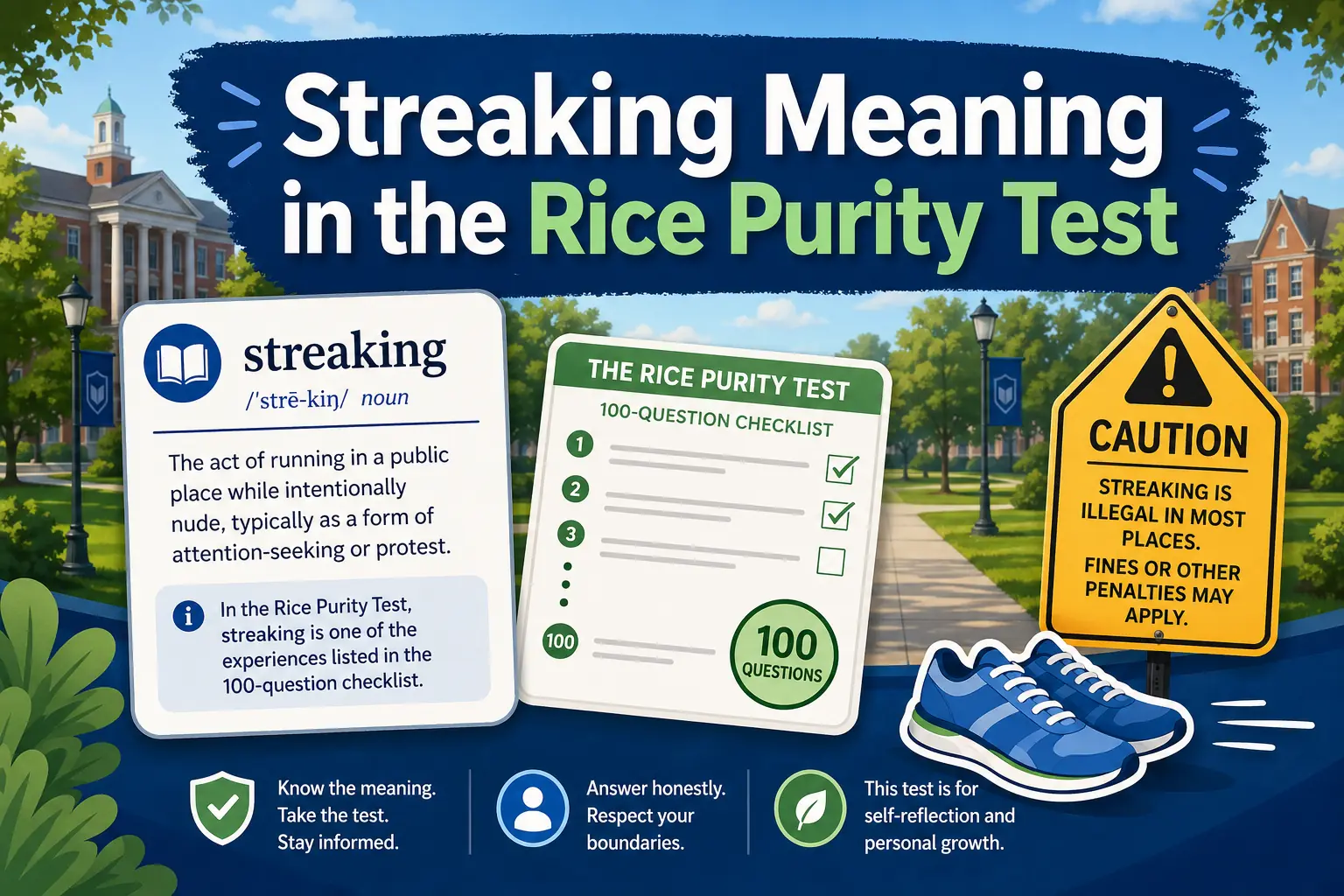
In the Rice Purity Test, streaking means running through a public or semi-public place while naked, usually as a prank, dare, or impulsive social act. The question is not asking whether you have changed clothes, been embarrassed, or gone swimming in a private setting. It is asking about a specific public nudity experience.
Quick Definition
If you searched what does streaking mean in the Rice Purity Test, the direct answer is simple: it means intentionally running naked in a place where other people could see you. In common usage, streaking is usually connected with public pranks, campus dares, sporting events, parties, or other social settings where someone removes clothing and runs through an area for attention or shock value.
The Rice Purity Test includes this term because the test asks about a broad range of life experiences, including social risk-taking, public embarrassment, rule-breaking, and impulsive behavior. It is one item among many, and answering yes to it does not define your character. It only means that one particular experience applies to you.
What Counts as Streaking?
The key parts are intentional nudity, movement through a visible place, and a public or semi-public audience. It does not have to be a giant crowd. A dorm hallway, campus lawn, street, party, sports field, or shared outdoor space could count if the action was deliberately done where others might see.
Context matters, but the Rice Purity Test is not asking for a legal analysis or a long explanation. It is a yes/no checklist. If the ordinary description "I went streaking" feels accurate, then the answer is probably yes. If the situation was accidental, private, or unrelated to public running, the answer is probably no.
| Situation | Would it usually count? | Why |
|---|---|---|
| Running naked across a campus lawn as a dare | Yes | It matches the common meaning of streaking: intentional public nudity plus running. |
| Running through a dorm hallway naked during a prank | Usually yes | A dorm hallway is not fully private, and other people could see it. |
| Skinny dipping with friends in a private pool | Usually no | It may involve nudity, but it is not the public running action implied by streaking. |
| Accidentally being seen while changing clothes | No | The action was accidental and not a streaking event. |
| Wearing underwear or a swimsuit while running as a joke | Usually no | Streaking normally means naked, not simply underdressed. |
What Does "Gone Streaking" Mean?
The phrase gone streaking means someone has participated in streaking. In the Rice Purity Test, a question like "Have you ever gone streaking?" is asking whether you personally did the act, not whether you watched someone else, heard a story about it, or saw a viral video online.
This is a useful distinction because some Rice Purity Test terms are easy to over-interpret. Watching a streaker at a sports event does not mean you went streaking. Being in a group where someone else did it also does not count unless you joined in. The test is about your own listed experiences.
If you are unsure how to answer, use the ordinary-language test: would you tell a friend, "I went streaking"? If yes, check it. If no, leave it unchecked. That simple standard is usually enough for a casual quiz.
Why Is Streaking in the Rice Purity Test?
The Rice Purity Test grew out of campus and youth social culture, where the checklist mixes dating, party behavior, substances, school-related rule-breaking, and public dares. Streaking fits that pattern because it combines social pressure, risk, impulsiveness, embarrassment, and public rule-breaking in one memorable example.
That does not mean the test is recommending streaking. It is not. It is simply asking whether a particular experience has happened. Many items on the test are descriptive rather than aspirational. A yes answer means "this happened," not "this was wise," "this was safe," or "this should be repeated."
For broader background on the original test's campus context, Rice University archival materials preserve purity-test documents from student culture, including records in the Rice archives. For a wider overview of purity tests as a category, the general purity test overview is a useful starting point.
Is Streaking Illegal?
Streaking can create legal risk because many places have laws against public nudity, indecent exposure, disorderly conduct, trespassing, or disrupting an event. The exact label depends on the location, circumstances, age of the people involved, whether anyone was targeted, and how local law defines the behavior.
In plain terms, the risk is not only social embarrassment. A prank in a public place can involve school discipline, event bans, police contact, fines, or more serious consequences. This is especially important for teenagers, because a dare that seems funny in a group chat can become much less funny when adults, school staff, or law enforcement get involved.
For general legal background, Cornell's Legal Information Institute explains indecent exposure as a legal concept. Laws vary, so anyone dealing with a real incident should look up local rules or speak with a qualified professional.
How Streaking Affects Your Rice Purity Score
In the standard Rice Purity Test scoring model, you start with 100 points. Each checked item means one listed experience applies to you, and the score drops by one point. So if the test includes a streaking question and you answer yes, that answer lowers your final score by one point.
That one point should not be overdramatized. A Rice Purity score is a checklist total, not a moral grade. Someone who has gone streaking once and someone who has not may have nearly identical scores overall. The test does not measure intent, harm, regret, maturity, or the full story behind an experience.
If your real goal is to understand your full result, use this article for the term and then read our Rice Purity Test score meaning guide or the score chart. Those pages explain how individual answers combine into a final score.
Streaking vs Similar Terms
People often confuse streaking with other nudity-related or prank-related situations. The difference matters because the Rice Purity Test uses short phrases, and short phrases can be ambiguous if you have never heard the term before.
| Term | Core idea | Main difference from streaking |
|---|---|---|
| Streaking | Running naked through a visible public or semi-public place. | It includes movement, nudity, and a public setting. |
| Skinny dipping | Swimming naked. | It is about swimming, often in a private or secluded setting. |
| Mooning | Briefly exposing one's backside as a joke or insult. | It is usually brief exposure, not running fully naked. |
| Flashing | Briefly exposing private parts. | It does not require running and may involve different legal and consent issues. |
For more definitions beyond this one term, use our full Rice Purity Test terms explained guide. This page is intentionally narrower so it can answer the streaking query more clearly.
How Teens Should Think About This Question
If you are a teen reading this because the question came up on the test, the safest takeaway is simple: do not treat streaking as a harmless requirement for being fun, mature, or adventurous. It can involve consent problems, legal risk, school consequences, unwanted photos, social fallout, and embarrassment that lasts longer than the joke.
A healthy answer to the test is honest, but it should not become a dare. If friends are using Rice Purity Test questions to pressure people into doing things, that is no longer a quiz. That is peer pressure. You do not owe anyone a lower score, a more dramatic story, or proof that you are willing to cross your own boundaries.
For age-specific context, see the Rice Purity Test for teens page or the newer Rice Purity Test for 16 year olds guide. Those pages focus more on score pressure, boundaries, and how younger readers can interpret the test without turning it into a competition.
Frequently Asked Questions
Final Takeaway
In the Rice Purity Test, streaking means intentionally running naked in a public or semi-public setting. It does not mean ordinary embarrassment, private nudity, watching someone else do it, or accidentally being seen while changing.
The term appears because the test includes social dares and risk-taking experiences. If the question applies to you, it affects the score by one point. If it does not apply, leave it unchecked. Either way, the safest interpretation is factual rather than dramatic.
Read More Test Terms View All Questions