What Does “Seen or Been Seen in a Sensual Context” Mean in the Rice Purity Test?
In the Rice Purity Test, “seen or been seen by another person in a sensual context” usually means that you saw someone, or someone saw you, in a situation that was intentionally intimate, romantic, or sexually suggestive. It is not asking about ordinary eye contact, normal clothing, medical situations, or accidentally being seen while changing.
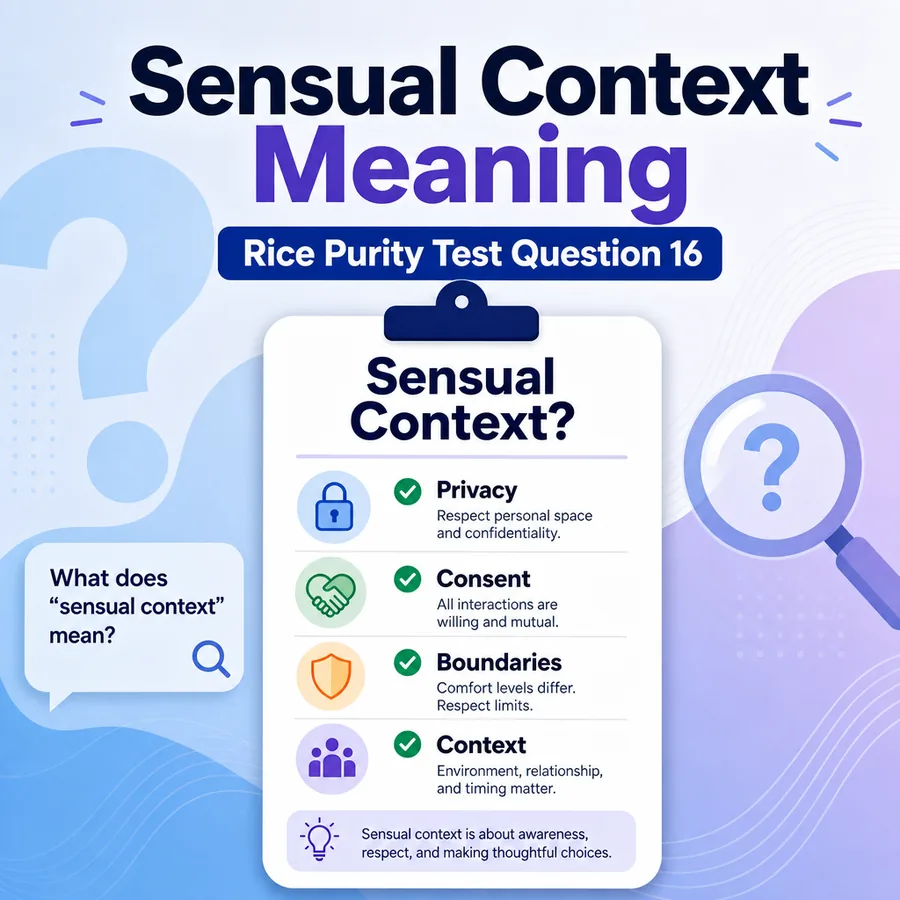
Quick Answer
If you searched sensual context meaning Rice Purity Test, the short answer is this: a sensual context is a situation with a clear intimate or suggestive tone. The question is asking whether there has been a moment where seeing or being seen carried that kind of meaning, rather than being neutral, accidental, or purely practical.
A helpful test is: would a reasonable person describe the moment as intimate, romantic, suggestive, or sexually charged? If yes, it may count. If the moment was accidental, clinical, routine, or unrelated to attraction, it usually does not count.
What “Sensual Context” Means Here
The word sensual can sound vague because it sits between ordinary affection and explicitly sexual behavior. In this Rice Purity Test item, it generally points to a setting where appearance, privacy, closeness, or partial exposure has an intimate meaning. The focus is not just what was visible. The focus is the context around it.
For example, a partner seeing you in a private romantic moment is different from a doctor seeing you during a medical exam. The physical visibility might seem similar in a literal sense, but the context is completely different. Rice Purity Test question 16 is aimed at the intimate version, not the neutral or necessary version.
This is also why the question uses both directions: seen or been seen. It can apply whether you were the person being viewed or the person who viewed someone else, as long as the situation itself was sensual in the ordinary-language sense.
What Usually Counts?
There is no official judge for every edge case, but the following examples show the ordinary interpretation. The more intentional, private, romantic, or suggestive the situation was, the more likely the answer is yes.
| Situation | Would it usually count? | Reason |
|---|---|---|
| A romantic partner sees you in a private intimate moment | Usually yes | The context is personal, mutual, and intimate rather than accidental. |
| You see someone else in a suggestive private moment and both people understand the tone | Usually yes | The item includes both seeing and being seen in a sensual context. |
| Flirtatious video chat or photo exchange where the point is attraction | Often yes | The medium is digital, but the context can still be intentionally sensual. |
| Accidentally walking in while someone is changing | Usually no | The situation is accidental and not intentionally intimate. |
| A medical exam, locker room, or caregiving situation | No | These are practical or clinical contexts, not sensual ones. |
What Does Not Count?
Many readers over-count this item because the wording is awkward. The phrase is not meant to include every time someone saw you looking attractive, every time you wore a swimsuit, or every time you felt embarrassed. It is about a context with intimate meaning.
- Normal public clothing, even if someone found it attractive, usually does not count.
- Being seen in a swimsuit at a pool or beach usually does not count by itself.
- Accidental exposure usually does not count because the sensual intent is missing.
- Medical, safety, sports, theater, costume, or caregiving situations usually do not count.
- Seeing a stranger online in an advertisement, movie, or random social post usually does not count as your own interpersonal experience.
The safest interpretation is to avoid stretching the question. If the moment was not interpersonal, not intimate, and not suggestive in context, it is probably a no.
How to Answer Question 16 Without Overthinking
Use this simple decision process. It keeps the answer tied to the actual wording instead of turning the question into a debate about every possible edge case.
- Was another person involved? The wording is about another person seeing you or you seeing another person.
- Was the moment intimate, romantic, or suggestive? If the tone was neutral, practical, accidental, or clinical, it probably does not count.
- Was there some level of awareness or intention? The phrase usually implies more than a random mistake.
- Would you naturally describe it as sensual? If that word feels clearly wrong, answer no.
Sensual Context vs Similar Rice Purity Test Terms
This item overlaps with several other Rice Purity Test questions, which is one reason people search for rice purity test question 16 meaning. The important point is that question 16 is about being seen or seeing someone in an intimate context. Other items ask about more specific actions.
| Term or item | Main idea | Difference from sensual context |
|---|---|---|
| Sensual context | Seeing or being seen in an intimate or suggestive situation. | It is about visual context, not necessarily touching or intercourse. |
| Fondled | Intimate touching. | Fondling involves touch; sensual context may only involve seeing. |
| Massaged sensually | Massage with romantic or intimate intent. | It involves physical contact and a specific action. |
| Sexual intercourse | A specific sexual act. | It is much more specific than being seen in an intimate context. |
| Streaking | Running naked in a public or semi-public place. | Streaking is public risk-taking; sensual context is usually private or interpersonal. |
For more definitions, see our Rice Purity Test terms explained guide. For the public-nudity term specifically, read what streaking means in the Rice Purity Test.
Does It Count If It Happened Online?
It can, depending on the situation. The Rice Purity Test was originally written before today’s online behavior was normal, so some modern cases require ordinary judgment. A mutual video chat, intentionally suggestive photo exchange, or private digital interaction can fit the same idea because another person is still seeing or being seen in a sensual context.
However, randomly viewing media online is different. A movie scene, advertisement, social media post, or anonymous image is usually not the interpersonal experience this question is asking about. The phrase points to a direct situation involving you and another person, not general exposure to content.
For teens, digital situations deserve extra caution. Consent, privacy, screenshots, age laws, and platform rules can make “just online” much more serious than it first appears. The test is not a dare, and a lower score is not worth a privacy risk. For practical help with intimate images online, the National Center for Missing & Exploited Children runs Take It Down, a service designed to help minors remove or limit the spread of certain online images.
How This Affects Your Rice Purity Score
The scoring impact is simple. In the standard Rice Purity Test, each checked item lowers the final score by one point. If you answer yes to “seen or been seen by another person in a sensual context,” it counts as one experience and reduces your score by one.
That does not mean the item is a moral grade. A Rice Purity score is a checklist result, not a full picture of your choices, boundaries, relationships, or maturity. Two people can have the same score for very different reasons, and one answer rarely changes the meaning of the whole result.
If you want broader score context, read our Rice Purity Test score meaning page or the Rice Purity Test score chart. Those pages explain score ranges, averages, and how individual items fit into the final number.
A Note on Consent, Privacy, and Boundaries
Because this question involves seeing or being seen in an intimate context, consent matters. A consensual private moment is different from spying, pressuring someone, sharing images, recording someone, or exposing someone without permission. The Rice Purity Test asks about experiences, but it does not explain the ethical or legal difference between healthy boundaries and harmful behavior.
If a situation involved pressure, coercion, unwanted viewing, secret recording, or sharing private images, treat that as serious. It is not just a score question. Talk to a trusted adult, counselor, legal professional, or local support resource if you need help understanding what happened or what to do next. RAINN's guide to what consent means is a useful plain-language reference for understanding clear, voluntary agreement.
For everyday quiz-taking, the practical rule is simple: answer honestly, keep private details private, and do not use the test to pressure anyone into sharing experiences they do not want to discuss.
Frequently Asked Questions
Final Takeaway
In the Rice Purity Test, sensual context means a situation where seeing or being seen has an intimate, romantic, or suggestive meaning. It does not usually include accidents, medical situations, normal swimwear, locker rooms, or practical visibility.
For question 16, answer yes only if the ordinary description fits your experience. The score impact is just one point, so the best approach is factual, private, and pressure-free.
View All Questions Read More Test Terms