Who made the Rice Purity Test? The best-documented answer is that no single inventor is identified in the historical account cited here. A 2017 retrospective by Rice's student newspaper, The Rice Thresher, traces a ten-question survey in 1924, a reappearance in 1974, a campus contest notice in 1980, and a 100-question version in 1988. Those records show the quiz changing over time; they do not establish one person's authorship.
What the historical record says
The most useful source for answering who made the Rice Purity Test is a retrospective published by The Rice Thresher on August 23, 2017. It revisits several versions that appeared in the paper and describes how their purpose and scoring changed. It is a historical report assembled decades after the earliest item, so it should be treated as a documented trail rather than a complete list of every copy ever circulated.
That distinction matters. People often use "the Rice Purity Test" to mean the familiar online checklist of 100 yes-or-no experiences. The newspaper's account shows that an earlier ten-question survey already carried the purity-test name, while the 100-question, one-point-per-item design arrived later. Saying that one student invented the modern quiz in the 1980s collapses those different milestones into a claim the source does not make.
The retrospective also does not provide a reliable byline for the person who drafted the 1924 questions. It connects later material to student-newspaper sections, but an edition's publication context is not the same as proof of an individual author's identity. For that reason, this page describes what the archive documents and leaves the unknown creator unknown.
A timeline of documented Rice Purity Test versions
The milestones below come from The Rice Thresher's historical review. The dates describe appearances recorded by the newspaper, not proof that the same wording or scoring was continuously used between them.
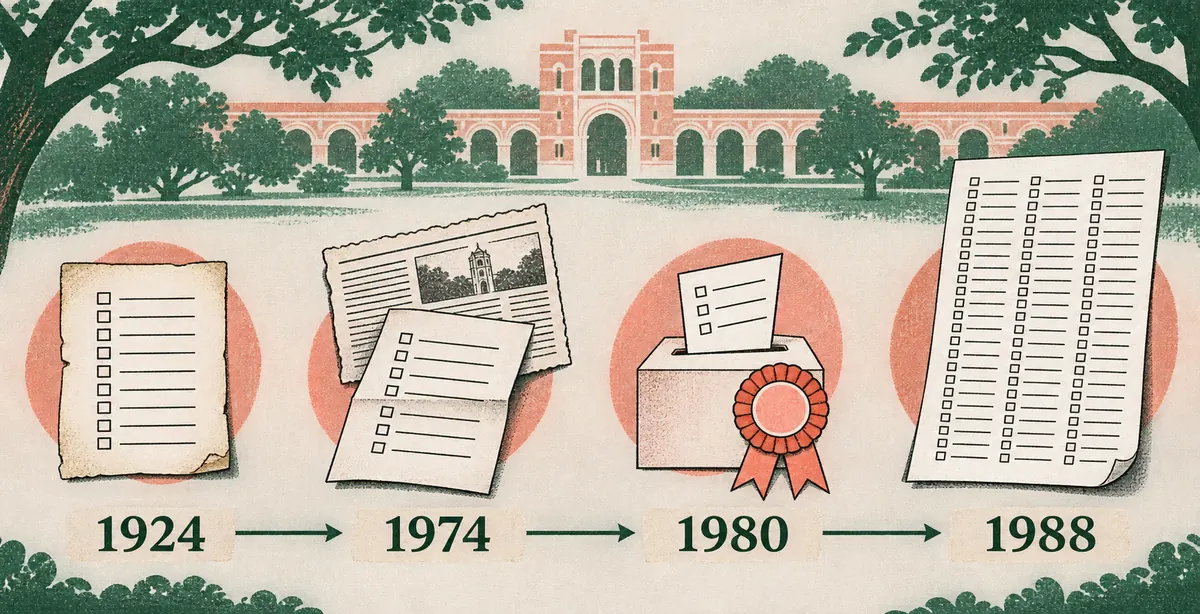
| Year | What the newspaper record describes |
|---|---|
| 1924 | A ten-question survey given to women; the retrospective reports results from 119 respondents. |
| 1974 | The ten-question test reappeared with a cut-out response form; the survey results were not published. |
| 1980 | A classified notice advertised a "First Annual Rice Purity Contest" for couples. |
| 1988 | The paper ran a substantially different version with 100 questions worth one point each. |
1924: a ten-question survey
The retrospective calls the 1924 item the original purity test in its account. It was a short survey aimed at women and reflected social assumptions of its era. The paper reports 119 respondents and an average score of 62. That figure belongs to this small, historically specific group; it is not a current student average and cannot describe how people today would answer a different checklist.
1974: the survey returns, but its results do not
Fifty years later, a ten-question version appeared again in The Rice Thresher. The paper printed a detachable form for readers to complete and mail back. The retrospective says those results were never published. This is evidence of a renewed campus use of the survey, but it leaves important details unanswered: there is no reported score distribution from that run and no evidence that every question stayed identical to the 1924 version.
1980: a contest notice, not a proof of annual editions
A 1980 classified advertisement referred to a "First Annual Rice Purity Contest." According to the retrospective, competing couples would begin with a score of 100 and try for the lowest combined score by sunrise. The notice shows that the test had become part of a social contest, but a phrase such as "first annual" does not prove that the contest happened every year or that its questionnaire was the same as the earlier survey.
1988: the recognizable 100-question structure appears
In 1988, The Rice Thresher ran a version with 100 questions, each worth one point. The retrospective contrasts it with the ten-question format, which assigned ten points to each item. The article appeared in the paper's Backpage and used language and categories that reflect the period in which it was written. This is the clearest dated milestone for the 100-item structure, but it still does not name one inventor of the entire test.
The same historical review describes later editorial changes to the wording. That is another reason to avoid treating a surviving 1988 list, a modern online quiz, and the 1924 survey as interchangeable. They share a name and a broad idea of tallying experiences, but they are not one unchanged questionnaire.
Why a single creator cannot be named from the available evidence
To answer "who invented the Rice Purity Test" responsibly, a source would need to identify the person who drafted the original survey or clearly credit a later creator. The retrospective provides a sequence of dated newspaper appearances, but it does not attribute the first list to a named individual. It also describes later editorial publication rather than a patent, university announcement, or formal institutional launch.
That leaves a useful but limited conclusion: Rice is the place associated with the early printed record, and The Rice Thresher is the source that documents its surviving milestones. The archive does not let us turn that association into a claim that a particular Rice student, professor, administrator, or office invented the test. Until a primary document supplies a name, attaching one would be speculation.
A dated newspaper item is stronger evidence than a repeated origin story, but this retrospective still has limits: it supports the chronology and changing format, not every author's identity or when copies first circulated outside the paper.
How the early survey differs from today's quiz
The biggest difference is format. The 1924 record describes ten questions, while the 1988 version had 100 items scored one point apiece. A score from one version therefore cannot be compared mechanically with a score from another. Even when two versions use a 0-to-100 scale, they may contain different questions, assumptions, and instructions.
Audience is another difference. The 1924 survey described by the newspaper was given to women. A campus contest in 1980 involved couples, while the later 100-item version addressed a wider set of experiences. The respondents, social setting, and purpose changed along with the questions. The reported average of 62 is consequently a historical detail, not a universal baseline.
Today's online Rice Purity Test pages may reproduce, revise, or adapt questions from different periods. Before comparing results, check the version's publisher, question count, and scoring instructions. If a page does not identify its source or date, treat its wording as that site's version rather than as an authoritative archival edition. A score is a checklist result, not a psychological diagnosis or a measure of a person's worth.
If you want to see how a current checklist is scored, you can take the online Rice Purity Test. For interpretation, read the site's guide to Rice Purity Test score meaning; neither page should be read as evidence about what students in 1924 or 1988 answered.
How to read the history without overclaiming
Use the dates as checkpoints. The 1924 survey establishes that a short purity test appeared in a Rice-related newspaper record decades before the familiar online format. The 1974 item shows a later reprint and an unpublished response effort. The 1980 notice records a contest concept. The 1988 issue documents the 100-question, one-point structure. Those are separate facts, and keeping them separate is more informative than compressing them into one supposed founding event.
Also separate what the source says from what it cannot show. A printed questionnaire can establish its wording and publication date. A classified notice can establish that an event was advertised. Neither automatically proves who wrote the questions, how many people participated, or whether later versions remained unchanged. When the article does not provide those details, the honest answer is that they remain unknown from this source.
The history is still useful even without a famous inventor. It explains why the Rice Purity Test is associated with Rice and how a campus survey grew into a more elaborate social checklist. It also shows that the quiz was edited over time, shaped by the norms of its period, and repurposed for different groups. That context helps readers understand both the name and the limits of claims made about its origin.
For a broader explanation of what the quiz measures and how its score works, continue to the Rice Purity Test complete guide. The history page answers a narrower question: what can be verified about the test's creator and the dated versions in the Rice Thresher record?
Frequently asked questions
Who made the Rice Purity Test?
The Rice Thresher retrospective documents successive versions but does not name one inventor. It connects the later 100-question version with the newspaper's Backpage in 1988, while the author of the 1924 survey remains unidentified in that account.
Did the Rice Purity Test begin in 1924?
1924 is the earliest version identified in the retrospective discussed here. It is safest to call it the earliest documented milestone in this source, rather than claim that no earlier questionnaire existed.
When did it become a 100-question test?
The Rice Thresher retrospective says a 100-question, one-point-per-item version ran in 1988. Earlier versions in the account had ten questions, so the familiar structure was a later development.
Was it an official Rice University test?
The evidence places versions in a student newspaper and campus social life. The cited history does not establish that a university office designed or administered the quiz as an official academic or psychological assessment.
Can the 1924 average score be compared with current scores?
No. It came from 119 women answering a ten-question survey in a different era. Modern checklists use a different audience, format, and set of questions, so the historical average is not a present-day norm.
Source
"Purity Test evolves, spreads beyond Rice," The Rice Thresher, August 23, 2017. The retrospective reviews the newspaper's 1924, 1974, 1980, and 1988 references and later wording changes.
The article distinguishes details reported by that retrospective from questions its account does not settle, including the identity of the first author.
Want the broader overview? Start with the complete Rice Purity Test guide, or try the online test and review your score privately.