Quick answer: choose the format before the topic
Fun tests to take with friends fall into four useful formats: private score checklists, discussion-based personality quizzes, team trivia, and live conversation games. Start by asking whether everyone wants private answers, a shared result, or a reason to talk.
A good rule is simple: participation is optional, questions can be skipped, and nobody has to show a score or explain an answer.

Which kind of test fits your friends?
Use the table as a starting point. “Best for” matters more than a test's title because the same quiz can feel fun for one group and awkward for another.
| Format | Best for | Typical result | Privacy level | Setup |
|---|---|---|---|---|
| Private checklist | Small groups comparing themes | Individual score | High if answers stay private | Low |
| Personality quiz | Conversation and reactions | Type or trait profile | Medium to high | Low |
| Trivia quiz | Teams and friendly competition | Team points | Low personal disclosure | Medium |
| Conversation game | Live stories and laughter | No fixed score | Depends on the group | Very low |
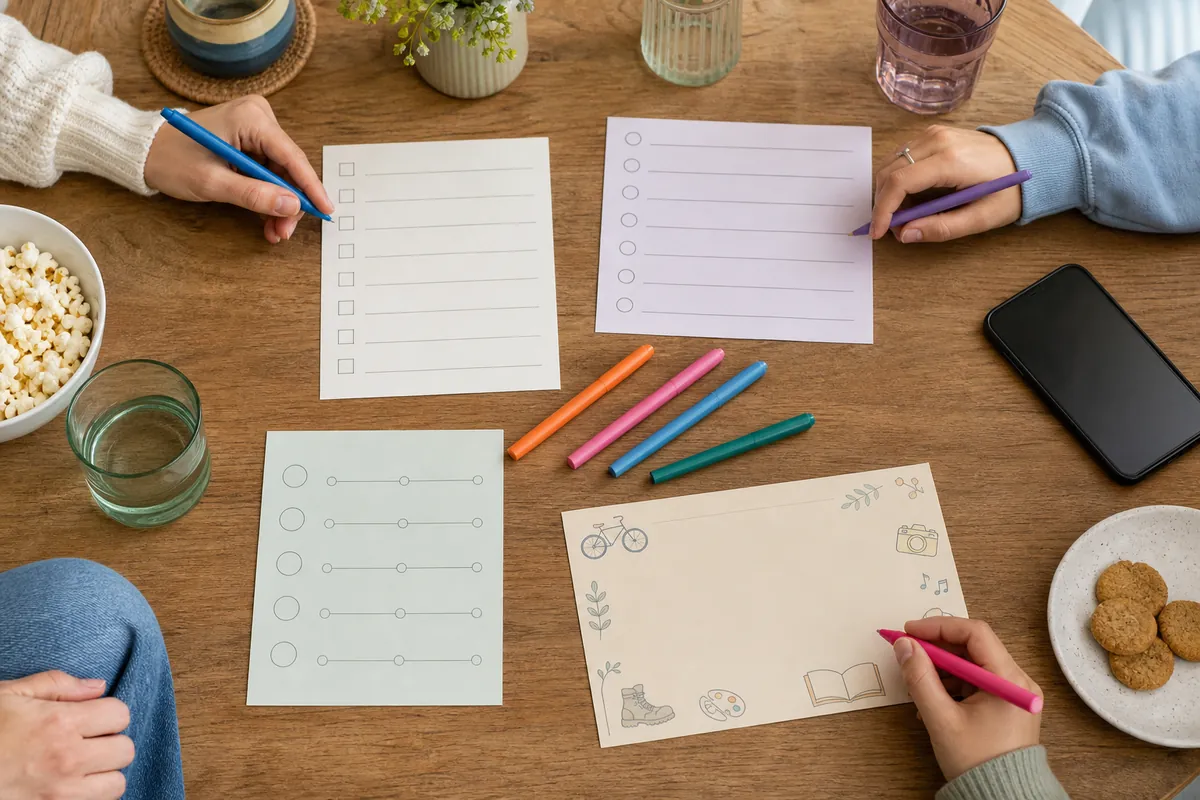
12 fun tests to take with friends
1Rice Purity Test
Best for a private checklist
The classic Rice Purity Test works when everyone understands that the score is personal, not a ranking. Each person can complete the questions privately and share only the final number—or keep that private too. If you want to understand the original format first, use the official Rice Purity Test and review the full question list before starting.
2Innocence Test
Best closest alternative
An Innocence Test keeps the checklist-and-score structure while giving a group another way to compare the experience. It is a useful choice when friends want a familiar format but do not need to take the same version everyone has already seen.
3AI Purity Test
Best for a current shared interest
The AI Purity Test shifts the subject from personal life experiences to chatbot, AI art, and everyday technology habits. It can feel easier for a mixed group because the questions are about a topic people can discuss without needing to reveal sensitive details.
4AO3 Purity Test
Best for fandom friends
For a group that reads or writes fanfiction, the AO3 Purity Test provides a shared vocabulary and a themed checklist. The fun comes from recognizing familiar fandom habits, not from proving who has the “best” result.
5Gaming or hobby purity test
Best for a specialist group
A themed test is often more comfortable than a broad personal quiz when everyone shares one interest. For example, the Valorant Rice Purity Test turns game habits, ranked matches, and player culture into a playful checklist.
6Personality quiz
Best for comparing reactions
A short personality quiz can give friends a topic to discuss after the results appear. Choose one with plain-language explanations and remember that a casual result is a conversation starter, not a permanent description of someone.
7Big Five-style questionnaire
Best for thoughtful reflection
A trait questionnaire is a good option when the group wants a calmer activity than a shocking checklist. Friends can compare which descriptions feel accurate, which do not, and how different situations change behavior. Keep the conversation curious rather than argumentative.
8Team trivia quiz
Best for low personal disclosure
Trivia is one of the safest group formats because the questions are about facts rather than private experiences. Split into teams, mix easy and difficult rounds, and include categories that different friends can contribute to. A short timed round keeps the activity moving.
9How well do you know me?
Best for established friend groups
Each person writes a few harmless answers about favorites, routines, or hypothetical choices. The group guesses, then the writer reveals the answer. Avoid questions about money, relationships, family conflict, or anything a friend might feel pressured to explain.
10Never Have I Ever
Best for live conversation
Never Have I Ever works as a flexible prompt game rather than a fixed test. Use light categories such as travel, food, school, hobbies, or awkward-but-safe moments. Every round should include an easy pass option; nobody should have to prove an answer.
11This-or-that or would-you-rather
Best for a quick icebreaker
Binary prompts are easy to run in a chat or around a table. They work well before a longer quiz because everyone can answer at their own level. Keep choices playful and avoid prompts that force friends to disclose sensitive information.
12Friendship values quiz
Best for a quieter group
A values-based quiz can ask about communication, planning, boundaries, or how someone likes to spend time. The best version compares preferences rather than declaring one friend more loyal or more compatible. Use the answers to plan a future activity, not to win an argument.
How to choose the right test for your group
Before sharing a link, decide what the group actually wants from the activity. A five-minute choice now prevents an awkward half-hour later.
| If your group wants... | Start with... | Avoid... |
|---|---|---|
| A result everyone can keep private | Rice Purity, Innocence, or a themed checklist | Reading individual answers aloud |
| Team competition | Trivia or a shared-answer quiz | Questions that depend on personal disclosure |
| Stories and laughter | Never Have I Ever or light prompts | Removing the pass option |
| A shared hobby | AO3, AI, gaming, or another themed test | Assuming every friend knows the same jargon |
| A thoughtful discussion | Personality or values questions | Treating a casual result as a diagnosis |
A five-minute setup plan
- Set the tone. Say whether the activity is private, team-based, or mainly for conversation.
- Choose a time limit. Ten to fifteen minutes is enough for a short quiz; longer tests should be optional.
- Pick a pass rule. Anyone can skip a question without explaining why.
- Decide what gets shared. A team score, final number, or funny reaction may be enough; screenshots are never required.
- End with an activity. Use the result to choose a movie, snack, game, or next conversation topic.
If the group is mostly new acquaintances, start with trivia or hobby questions. Save more personal checklists for a setting where people already trust each other.
Privacy and comfort rules matter more than the score

- Keep individual answers optional. A shared final score should never require a public confession.
- Use age-appropriate prompts. Teenagers and younger participants should be able to skip sensitive questions and choose a hobby or trivia format instead.
- Do not turn results into rankings. A higher or lower number does not prove maturity, goodness, popularity, or compatibility.
- Be careful with screenshots. Results can reveal personal details even when the quiz feels like a joke.
- Stop when the mood changes. If someone looks uncomfortable, change the category or end the round.
For more context on the original checklist, read the Rice Purity Test score meaning guide. For a broader comparison of alternatives, see tests like the Rice Purity Test.
Frequently asked questions
What are the best fun tests to take with friends?
The best choice depends on the group. Use a private checklist for individual results, trivia for teams, a personality quiz for discussion, or a conversation game when people want live interaction. Pick a format everyone understands and allow anyone to pass.
What is a good online test for a group of friends?
A short themed quiz, trivia round, or private Rice Purity-style checklist can work well. The right option depends on whether the group wants a score, shared answers, a hobby topic, or a low-pressure conversation.
How can friends take a quiz without making anyone uncomfortable?
Agree that answers are optional, let people skip questions, avoid demanding screenshots, and do not rank friends by scores. Private results are often more comfortable than reading every answer aloud.
Are personality tests fun to take with friends?
They can be fun when treated as conversation starters rather than scientific labels. Compare patterns and reactions, but do not use a casual quiz to diagnose someone or define the whole friendship.
Can teenagers take fun tests with friends?
Teenagers should choose age-appropriate, clearly explained prompts, skip anything uncomfortable, and keep detailed answers private. A hobby quiz or trivia game may be a better group option than a sensitive life-experience checklist.
Bottom line
There is no single best test for every friend group. Choose a private checklist when people want individual results, trivia when teams want competition, a themed quiz when everyone shares an interest, and conversation prompts when the goal is simply to talk and laugh.
The most successful group activity leaves room for a pass, protects personal answers, and gives people something useful to do together after the result appears.